

Habeus Corpus Petitions and a Day Trip
It is starting to get a bit chillier in La Plata as the winter solstice rapidly approaches. This week I started taking a Spanish class at a local community center to refresh my memory of various grammar rules and learn some specific words used in this region of South America. My teacher Maria is lovely and has already been an excellent resource regarding Argentinean Spanish. She has also introduced me to sweet mate. I was familiar with the tea most Argentines seem to be fanatics about. However, I did not realize it could also be taken with a generous heaping of sugar. With my perpetual sweet tooth, I absolutely adore this variation of the Argentine national beverage.
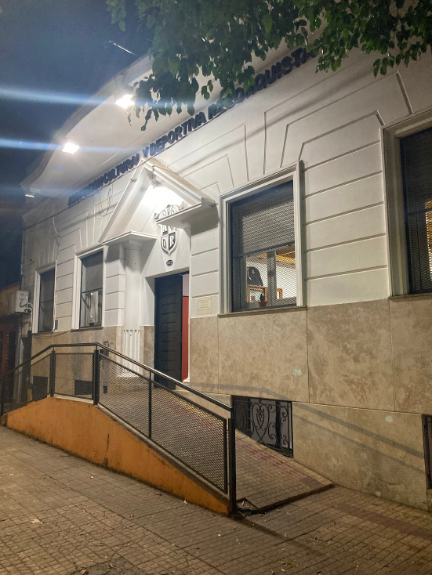
In addition to being a place for language classes, the community center also hosts multiple basketball courts and a small library. There is truly never a dull moment when reviewing irregular verb tenses amidst the sounds of dribbling balls and youthful shrieks. I am excited to say I also checked out a few books this week to continue working on developing my language skills. Between reading cases in Spanish at my internship and now working through a mystery novel, I feel like I am rapidly becoming more comfortable with the language again after the yearlong break since I finished my undergraduate Spanish coursework.
This week at work I am becoming acquainted with the structure of habeus corpus petitions the Commission brings on behalf of prisoners in response to horrific prison conditions which violate international law. I have learned so much about various international legal rules the Commission invokes to defend the rights of those neglected or abused by the prison system. The most frequently cited international instruments in these petitions include the Nelson Mandela rules (The United Nations Standard Minimum Rules for the Treatment of prisoners) and the Bangkok rules (The United Nations Rules for the Treatment of Women Prisoners and Non-custodial Measures for Women Offenders) as well as the Organization of American States’ Inter-American Convention to Prevent and Punish Torture.
In other news, this past Friday evening a winged creature flew into the third floor of the CECU residence. Upon reaching the top of the stairs and seeing something flapping about I called down the stairs to some of my friends that there was a “Pájaro” (or bird) in the house. A chorus of “Qué?!”s erupted from the group of girls gathered on the landing of the floor below. Thinking I had perhaps misremembered the word for bird I racked my brain for a different word. Unable to come up with anything else, I stammered, “Ummm bird? Pájaro?” The group climbed the stairs and quickly corrected me, explaining that the animal was a murciélago (a bat) which are apparently extremely common in La Plata around this time of year. We spent the next twenty or so minutes attempting to wrangle the bat into a hamper before successfully completing our objective. All the while my friends teased me (in good fun) for first thinking the bat was a bird.
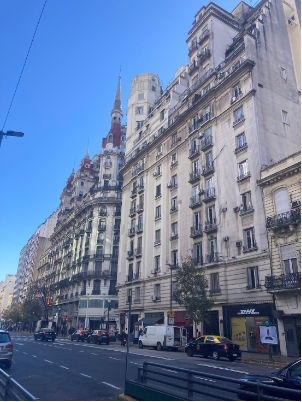
On Saturday I took a solo daytrip into Buenos Aires which is about an hour train ride from La Plata. To say I was absolutely enthralled by the capital city would be an understatement. The broad avenues and historic Beaux-Arts architecture are breathtaking. I enjoyed an alfajor while strolling past the iconic Buenos Aires obelisk (which of course reminded me wistfully of my birth city’s own famous obelisk, the Washington Monument).
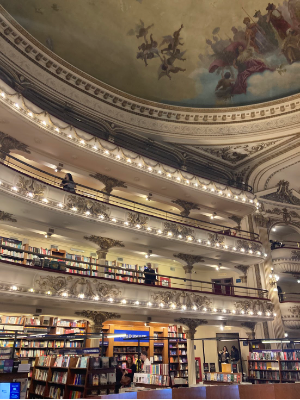
I also wandered around the shelves of El Ateneo, a stunning early 20th century theater turned bookstore that I first glanced in the pages of a sixth-grade Spanish textbook. It was surreal to see the endless shelves of books amongst the ornately carved balconies and detailed ceiling fresco in real life.
Buenos Aires is an enormous, energetic city, and I will have to return multiple times this summer to explore more. I feel so lucky to be able to learn so much here in Argentina while also exploring such distinct, dazzling places.