Week 7: Research and Reunion
This week I hosted my seminar on worker classification. China is also dealing with the effects of a growing Gig Economy. Like in the U.S., the lines between different types of worker classification have become increasingly blurred, and many workers are losing out on protections offered to traditional employees. My research focuses on California ABC test for worker classification. This new modern test enables to gig workers to more effectively claim employee status by shifting the burden of proof to the employing entity. Employers must prove three elements to deny a worker employee status: (1) that the worker is free from the control and direction of the hiring entity; (2) that the work performed is outside the usual course of the hiring entity’s business; and (3) that the worker is customarily engaged in an independently established trade or occupation. The second element is especially difficult for gig platforms to prove and has resulted in some landmark cases involving Uber, where drivers successfully established themselves as employees.
My research also explored worker classification legislation in other countries such as the U.K. and Germany, where they are creating hybrid classifications to span the gap between independent contractor and employee. These hybrid classifications guarantee workers a suite of basic rights, which is a step up from the protections offered to independent contractors. In China, this new ABC test can be applied in a similar fashion. Like in Western nations, China has built a vast rideshare and delivery infrastructure, and many of the workers who sustain it come from vulnerable groups such as rural migrant workers. These workers often lack access to stable employment protections, healthcare, and social security benefits, making them especially susceptible to exploitation under traditional independent contractor frameworks. By adapting the ABC test or creating hybrid classifications similar to the U.K. and Germany, China has an opportunity to better balance labor flexibility with worker protection.
At the same time, challenges remain. The highly localized nature of Chinese labor regulation, combined with the rapid pace of digital platform innovation, complicates nationwide implementation. Enforcement would require not only legislative clarity but also consistent judicial interpretation and administrative oversight. However, the global momentum toward recognizing gig workers as more than just “independent contractors” provides China with comparative experiences to draw upon. If properly tailored, reforms could strengthen labor protections while sustaining the growth of the digital economy.
Ultimately, worker classification has become a transnational challenge shaped by globalization and shifting economic structures. By studying the ABC test, hybrid models, and China’s gig economy, we see how legal systems are actively grappling with the evolving realities of work. The question moving forward is not whether reform will come, but how quickly and in what form it will arrive.
___
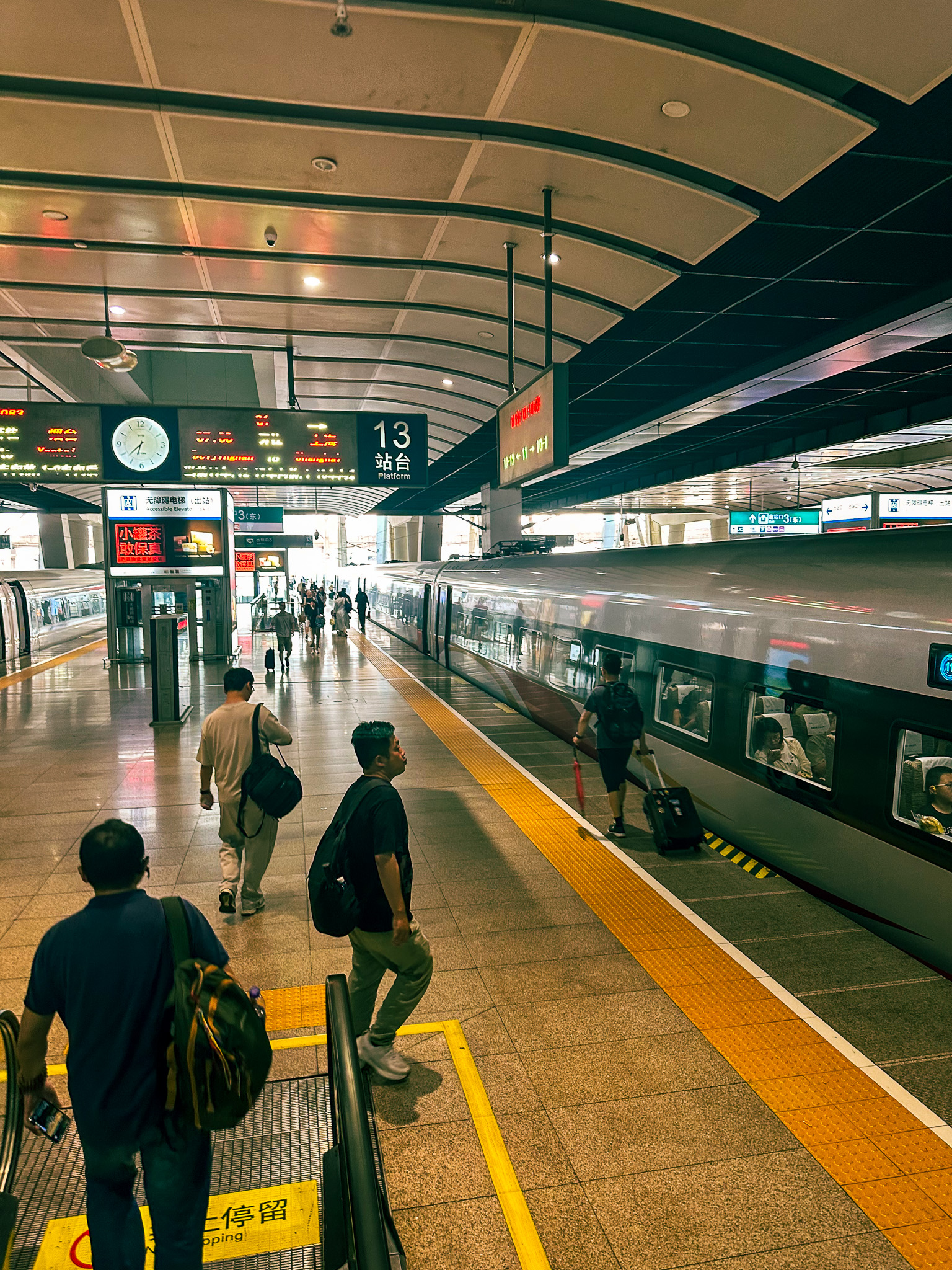
Having completed my seminar, I thought it would be a good time to take a mini vacation. A friend and colleague invited Logan and I to Shanghai and we jumped at the opportunity. We decided to take the high-speed rail as it was cheaper and only slightly slower than taking a flight. When we arrived at the station, I was a little nervous as it was the first time I have taken the high-speed rail. However, the process was extremely simple as everything was already linked to your passport. With minimal fuss, we were able to board the train and set out for Shanghai.
 Arriving at the Shanghai station, we were hit by an instant increase in humidity. Memories of childhood summers spent in Shanghai returned, reinforced by the constant buzzing of cicadas. It has been almost ten years since I was last in Shanghai, and the summer heat has not changed a bit. As we took a Didi further into the city from the station, unfamiliar overpasses loomed over us, newly built and a testament to how quickly the city has developed in the last decade.
My first order of business was to visit my family in the city. Like the summer heat, my aunt has not changed much and met me with her usual bubbly personality and welcoming smile. We had a traditional home-cooked Shanghai lunch. Something I missed dearly and made me realize how diverse cuisine was across China. After settling in for a bit, I then set out to meet my friend.
With Logan in tow, we met my friend at a Michelin star restaurant. Three of his friends joined us and we enjoyed some of the best traditional Shanghai dishes I have ever had. Despite having a Michelin star, the pricing was very reasonable by American standards, and we only paid about $30 each. We then set out for the Museum of Art Pudong, where they were hosting an exhibition from Musee d’Orsay. At the Museum, we saw western masterpieces from Van Gogh and Monet, something I wasn’t expecting to be able to see in China of all places. After fighting through the crowds to see the pieces we were hoping to see, we decided to head to bed and get some rest.
I decided to spend my last day in Shanghai with my family and was able to visit my grandma who just turned 90. I was overjoyed to see that she was in great health and was also able to practice the Shanghai dialect a little. I am happy to report that my listening comprehension is still mostly there, but speaking it is another matter entirely. However. our reunion was cut short since I had to catch the train back to Beijing. That said I am looking forward to seeing them again shortly as I have planned to return to Shanghai after my internship concludes.
That’s it for this week! A stark contrast in pace from the last few, but definitely a welcome change. A little exhausted, but I am returning back to Beijing happy and satisfied, reconnected with my family, and connected with new friends.