

Introduction/Week 1: "Thunderstruck"
 “Culture Shock” is a term that gets thrown around a lot, okay, well not that much, but it is one of those phrases that is easy to hear without the true meaning of it being conveyed. If a picture is worth a thousand words, then an experience is worth a million, and any attempt to put it to paper will always fall short of the actual sensations felt in the moment. I learned that the moment I landed at Beijing Capital International Airport last week. I couldn’t have possibly imagined how infinitesimally small my world was until I stepped off that airplane. The feeling was electric, the surge of excitement, uncertainty, and so many other feelings all at once shook me to my core.
Introduction:
However, before we get into the travel log, some introduction is in order. My name is Logan Smith, and this summer I will be interning for Zhicheng Public Interest Lawyers in Beijing, China.
They are the largest public interest legal group in China and deal with a wide range of issues, including children’s rights, migrant workers’ rights, criminal legal aid, foundational childcare, and nonprofit organizations’ legal services. They have primarily brought interns like me and Alex in to provide insights into how Western legal systems are approaching specific topics/issues they are looking to address. Throughout the summer, we’ll be doing in-depth research on these issues, discussing them with the director, our supervisors, and the other interns, and then eventually presenting this information in the form of a seminar to hopefully start a wider discussion on them.
The central topic Director Tong wants us to look into is “Users’ Rights.” So what are they? Well, the answer to that question requires some additional context. Throughout all previous agricultural and industrial areas of human history, power was unified into the singular entities of States. These States have to weigh their own power and control against the civil rights of their citizens. They are supposed to be kept in check by the fact that their power is derived from the collective approval of their citizens, who are giving up those rights in exchange for a mediator who can resolve disputes en masse. This is John Locke’s social contract in its simplest form, and it helps us better understand where our rights come from and how we can protect them.
In the past few decades, an entirely new type of power has cropped up: Digital Power. Digital platforms, unlike traditional companies, are not primarily looking for/benefiting from consumption(purchases). They primarily want two things: the user’s data and the digital traffic of the user’s attention. They then get economic benefits from them by using them to improve their platform to better collect both or by selling them because other entities(governments, companies, people) want that data and want that attention. These platforms are able to use algorithms, artificial intelligence, and various other technologies to increase their hold over the average user. To increase the importance of that virtual space in their day-to-day life.
This allows them to control what you see, hear, and think about. It also allows them to directly manage what you can say and do on their platform through rules and the penalties that come with breaking them. Penalties can have serious consequences for your economic and personal lives. Unlike regular companies, this goes beyond economic consequences and has a direct effect on how you exercise your personal rights. This is an extreme level of control that exists beyond the borders of any individual State and affects billions of people. “No king in history has been the ruler of two billion people, but Mark Zuckerberg is.” We are now all living in a “triadic governance model” where national power, digital power, and civil rights are actively fighting for supremacy.
Users’ Rights are a combination of traditional civil rights and the broader humanitarian issues(the effect this is having on the politics of individual States) refracted through the lens of each person’s interactions with these digital platforms. Things like the right to access information, the right to freedom of speech, the right not to be manipulated for the sole purpose of becoming tools to be used by these platforms, and so much more. This is an extremely complex, important, and underdeveloped issue that is hard to express in simple terms. It invalidates any of our traditional approaches to governance and rights issues, and any answer I can give you is a vast oversimplification, even though at this point I’ve typed hundreds of words attempting to explain it. However, I’ll do my best to boil it down. Users’ Rights are about getting fair moral treatment by companies that want to take the mental capacity of the user and sell it as a product. These rights aim to minimize exploitation of the users and allow for a free and fair digital space.
By researching specific topics, we will hopefully fill in a puzzle piece to this wider problem. I am personally researching A.I. companion chatbots. There have already been multiple examples of these platforms causing severe harm to people, especially children. The design of these chatbots helps illustrate the economics of data collection and how it leads to the exploitation of users, and frankly, it is pretty insidious. Since this blog post is already extremely long, I’ll go more in-depth on it next week. I’d recommend googling the name Sewell Setzer III, as his story is at the heart of this issue.
Travel Log:
You’d think that at some point in the physical process of travelling across the planet, mentally I would have put two and two together and braced for the fact that I was going to be in a country and culture wholly distinct from my own. Unfortunately, dear readers, this was not the case. My brain was completely detached from reality while my sleep-deprived husk drifted ever closer to our final destination. When I landed at the airport, it all hit me at once. I was really about as far away from home as humanly possible in a country where I can’t speak or read the language.
The immediate feelings you get are excitement and amazement. It’s so easy to live a life that has become one colossal rut where even the things that bring you joy begin to bore you to tears. I got a chance to truly hit the reset button. Everything suddenly became interesting again. I’ve been able to see things I never even imagined, it feels like winning the lottery. Even now, I still feel so lucky. It’s a once-in-a-lifetime opportunity that makes everything worth it.
 Beijing is massive, of course, every city is massive to some extent, but even among them, Beijing is a goliath. The city just seemingly stretches on and on and on. Every time I get an elevated view of things, it is truly mind-blowing, the scale is baffling, and even crazier is that despite having so many people living in it, you don’t feel the crowd when walking around. There’s so much space compared to American cities. From my past experience, it usually felt like I was constantly surrounded by other people; here, that is not the case. The city is also incredibly green. In my mind, I was expecting a full urban sprawl, but it is very well populated with plant life, which I think helps make it feel a lot less constricting. Even the subways aren’t as busy as you’d think. There are peak hours during the day where, yes, you’ll have about a centimeter of distance between you and the person next to you, but overall, you usually have plenty of free space.
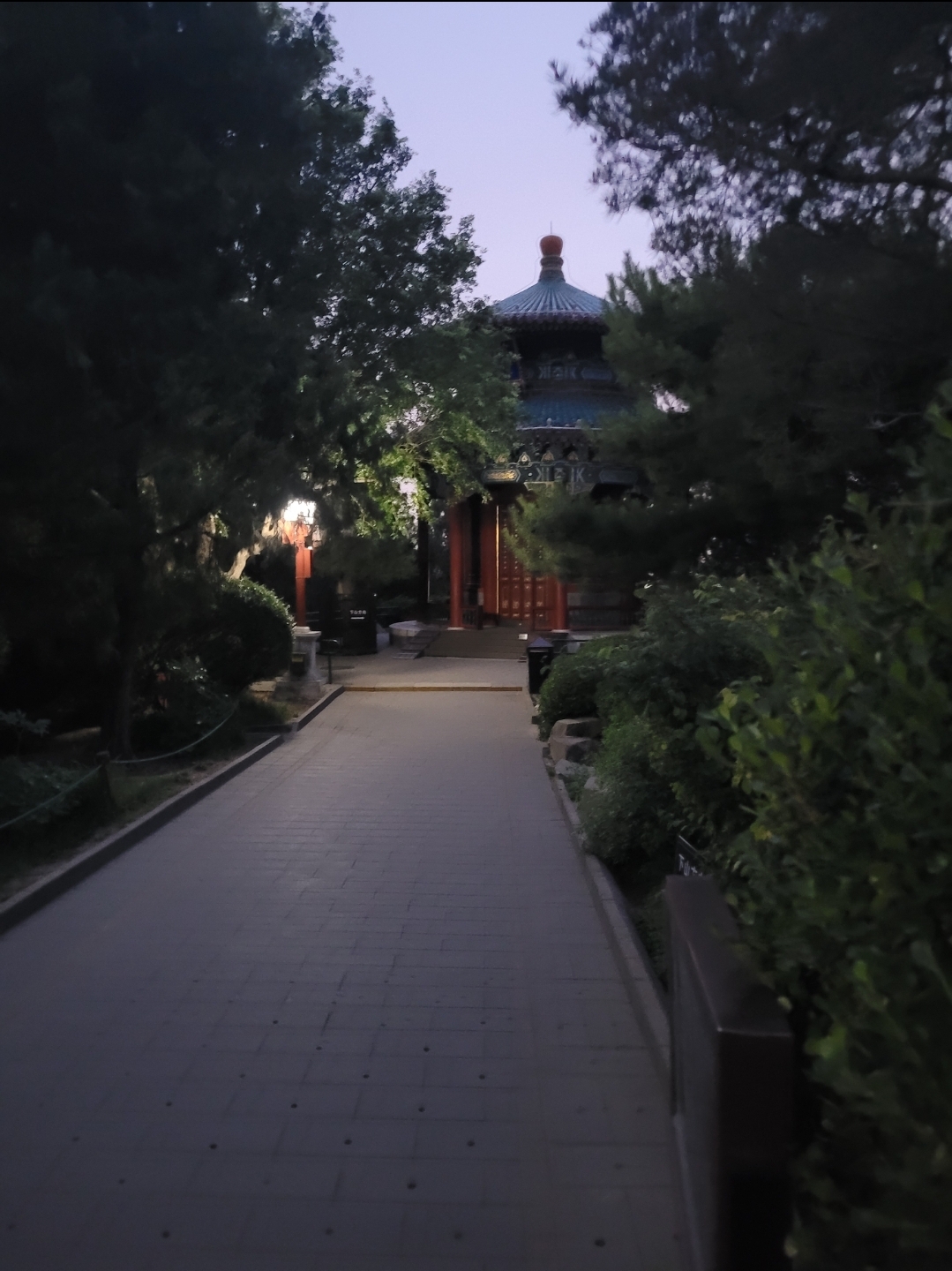
 The historical sites are incredible. Alex and I got to visit Jingshan Park, the Temple of Heaven, the park surrounding it, and the Forbidden City, all during our first week. At each of them, I was completely geeking out, the architecture was incredible, and you really felt that sense of history tied to each location. The Forbidden City has to be seen to be believed, much like the city encasing it. The scale of it all was shocking. The two parks were also just really fantastic, even beyond the architecture. The parks were essentially forests just jutting out of the city, with so many tall trees. Everywhere I've gone feels like its own little ecosystem.
When those first two fade out a bit, the next two feelings set in: stress and embarrassment. Not being able to fully communicate with people or read most signs is rough. So many simple things become infinitely more complicated and difficult to figure out. For example, on my first day, I ordered a DiDi(China’s Uber) to take me from the airport to my apartment, the GPS on the app was inaccurate so I couldn’t find the car, the driver called me and instantly it hit me: I had no clue how to explain where I was. Such a simple thing suddenly became about a 15 or 20-minute ordeal. Eventually, I just gave a physical description of myself in Chinese with the few words I knew, and they were able to find me. Even simply speaking those few phrases is tough because my reflexive reaction was to go dead silent. It’s like being a baby bird and learning how to fly. You have to bypass the fear-based gut reaction to be able to do anything. I owe Alex and his parents big time because they got the apartment details worked out, which saved me a huge headache.
 Anyway, at various points, similar interactions would repeat where a payment wouldn’t go through, or I needed something but didn’t know how to ask. It would be a whole thing, and by Day 3, I was stressed. There was also this pervasive feeling of embarrassment. Most major U.S. cities have a very wide variety of people, which makes it easy to blend in regardless of who you are. That is simply not the case in Beijing, I stick out like a sore thumb. On paper, I thought that wouldn’t really bother me, but it definitely does. People don’t directly stare at me, yet there’s this pervasive feeling of being watched, like any minor mistake could be amplified to a very large degree. For example, I am very bad with chopsticks, and of course, the staff notices every single time. So to help me out, they give me plastic gloves, literal kiddie gloves, and although they are just being considerate, it feels like I might as well have gotten a dunce hat. However, everyone was very kind and understanding in every interaction I had, which certainly helped reduce a lot of the anxiety from these interactions as time went on. Most of the awkwardness that comes from it is self-inflicted, and it gets easier with each passing day.
 The last feeling that comes is the returning sense of normalcy. As large of a shock as being here is, even in the first week, I started to get into a routine. The stress faded, and everything started to feel natural. You really start to notice that people are people anywhere you go, so much feels the same, and life goes on just as it always has. Losing that initial shock so quickly was surprising, and honestly, part of me wishes I had taken it in more. I’m not sure I’ll ever feel that way again, but it was traded in for a far richer feeling. There’s a particular story that comes to mind. Alex and I had just left the Temple of Heaven, it had gotten fairly late, and we stumbled into a Dairy Queen. I ended up ordering a blizzard, and I suppose that there was a new hire because the other employee showed them how to do the upside-down flip trick. The new employee then replicated it, and we all ended up laughing because of the slight awkwardness of it all. It was a goofy moment, but it felt so familiar. Having that day, which was filled with these amazing, jaw-dropping sights, contrasted with these intimate human moments, gave me such an indescribable feeling of happiness. To me, life is defined by the mundane as much as it is by the marvelous. Getting to live somewhere for a longer period of time allows you to take it all in and develop a more intimate appreciation for life there that lasts long after that first jolt. I only hope that through these blogs I can express some of that feeling to you.
Thanks for reading,
Logan Smith