

Week 3: "Cats on Mars"
Dear readers, it's the moment you’ve all been waiting for, the one thing you have to visit while in China…
Drumroll, please…
The Great Wall
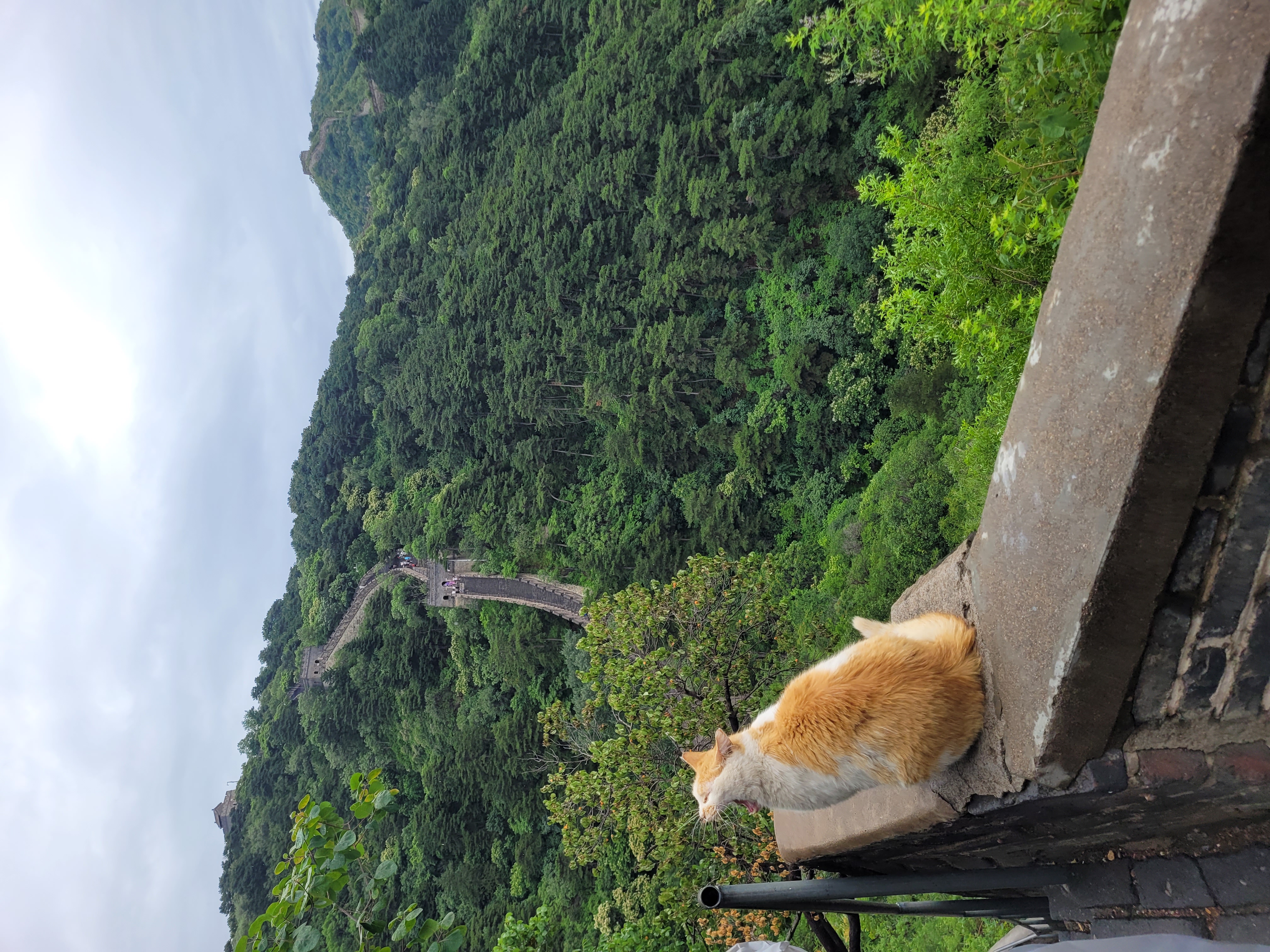
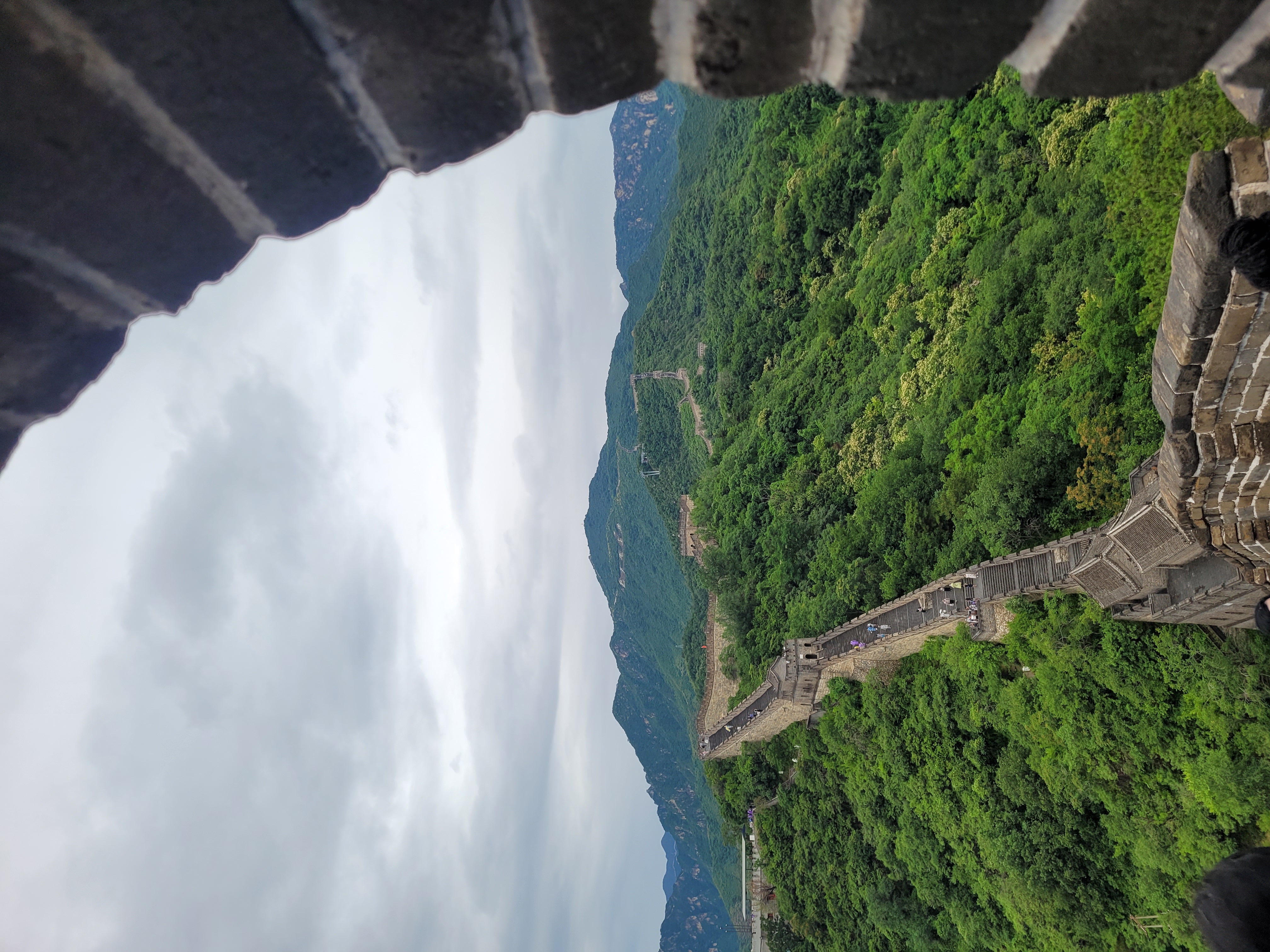
A stone serpent slithering over thousands of miles of fields, plains, and mountains. A man-made leviathan visible from space, each section is a testament to the ingenuity and resiliant spirit of humanity, aaaand let me guess you were so distracted by the cat you didn’t process a single word I just wrote.
 Unbelievable, for some context, the section we’re on is known as Mutianyu, it's the quintessential Great Wall experience. You know the kind of view they put on the front of World History textbooks to spark the imagination of kids. Four-thousand steps worth of climbing(or the much more convenient ski-lifts) to reach this section which is grafted onto the spine of the mountain, scraping the heavens, valleys, lakes, and streams shrink into forms resembling an intangible diorama, and Beijing’s skyline becomes abstracted into its most memorable shapes just barely clinging onto the horizon. Even as one of the most well-maintained sections of the Wall, you can feel hundreds of years of wear and tear gnawing away at it, and certain sections of stairs are so vertical you may as well be climbing. Despite all that, somehow, someway, stray cats managed to get all the way up here.
 The sheer resilience of Felis catus is on full display, fighting against nature, exhaustion, and the elements, all so they could… mooch off of a bunch of easily impressed tourists and lie around all day. Simply remarkable. Look at these adorable, smug little jerks.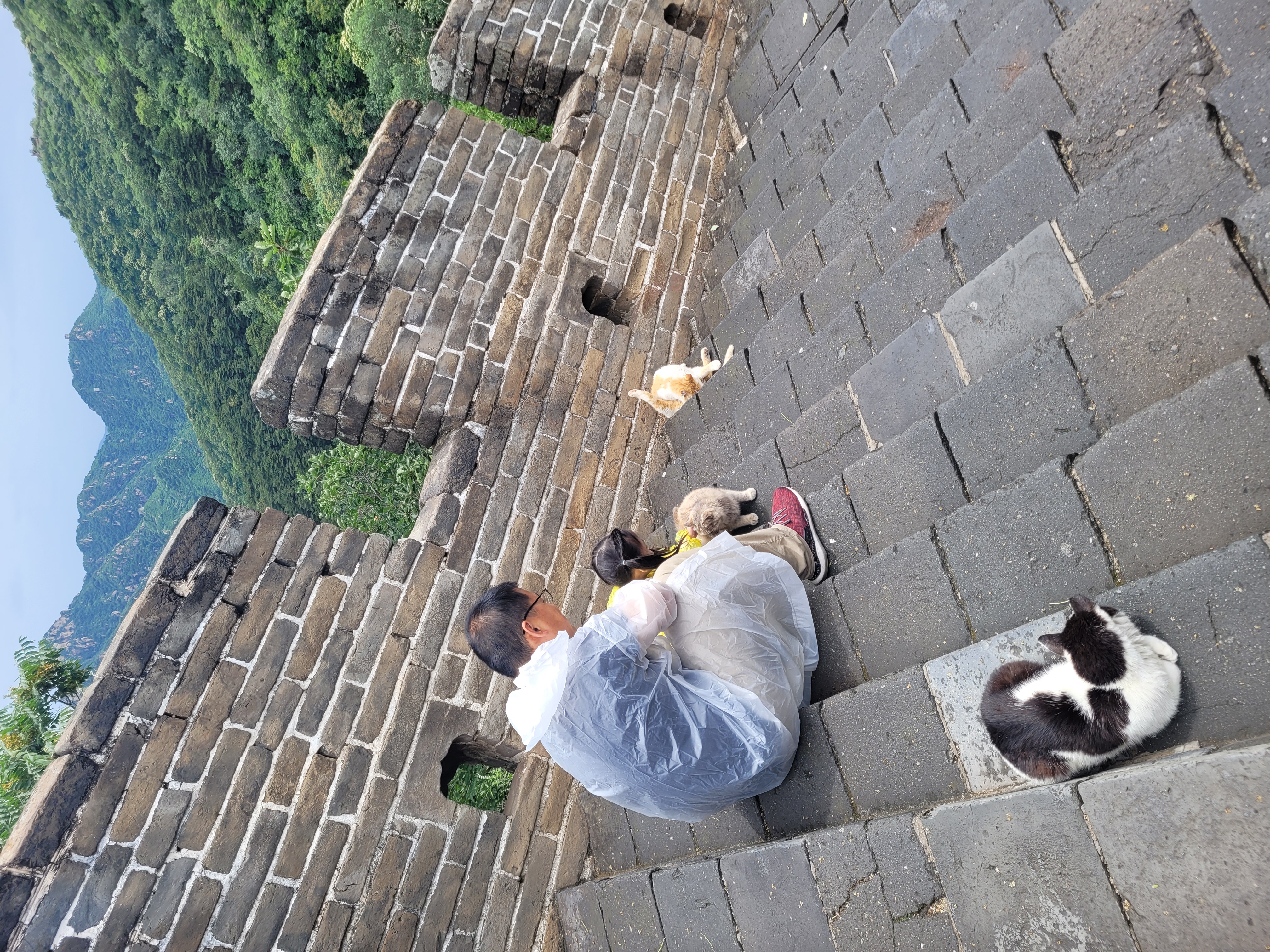
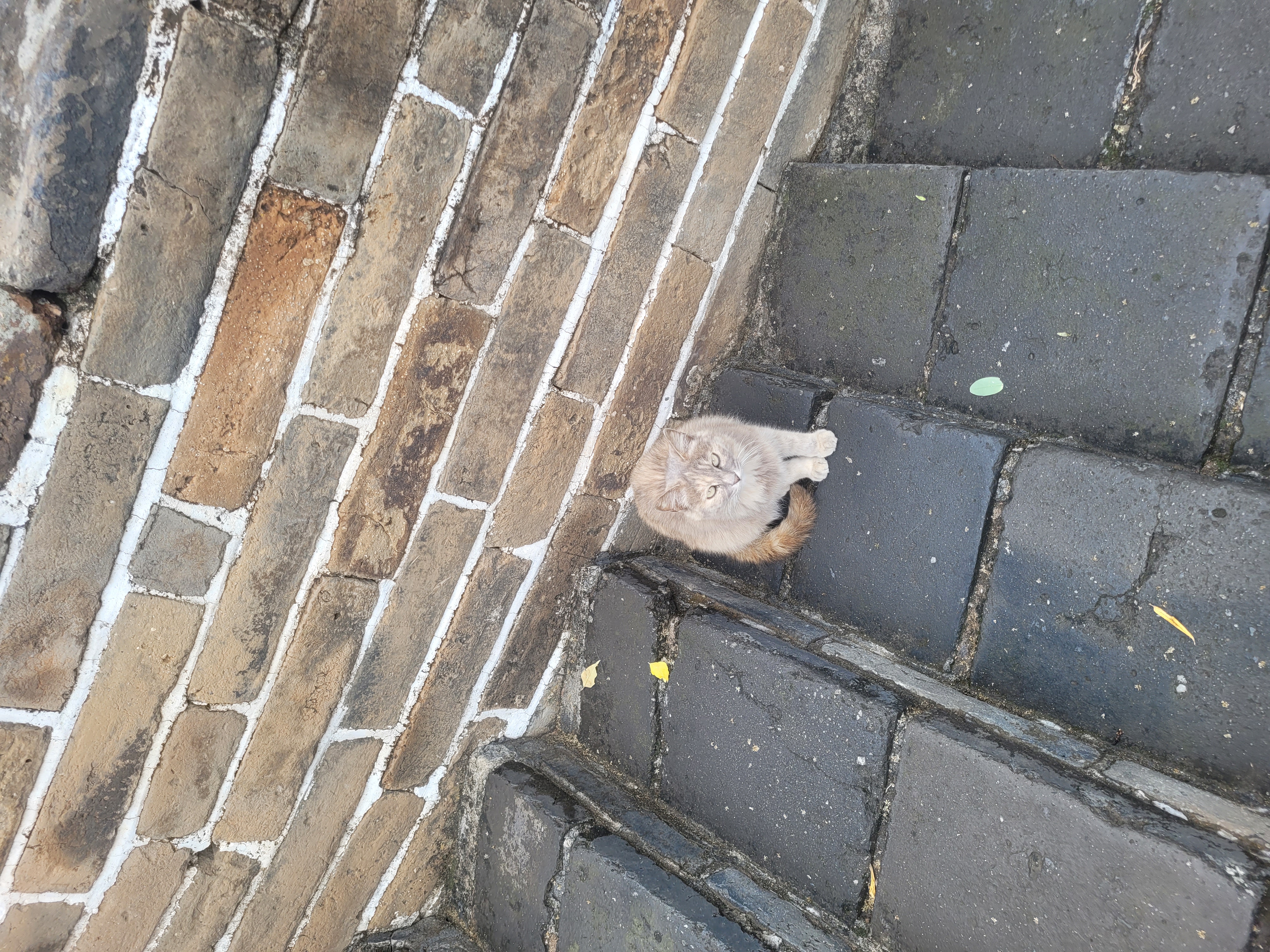 Smothering that feeling of grandeur and importance that was swelling within my chest before it could even take its first breath. The beautiful contrast and underlying tension in a man-made structure pushing directly against nature to achieve its purpose, yet it's all so easily broken by the presence of these little furballs. But in its own way, that's also pretty amazing and I’d have to take some of that inner strength to heart for the latter half of my day.
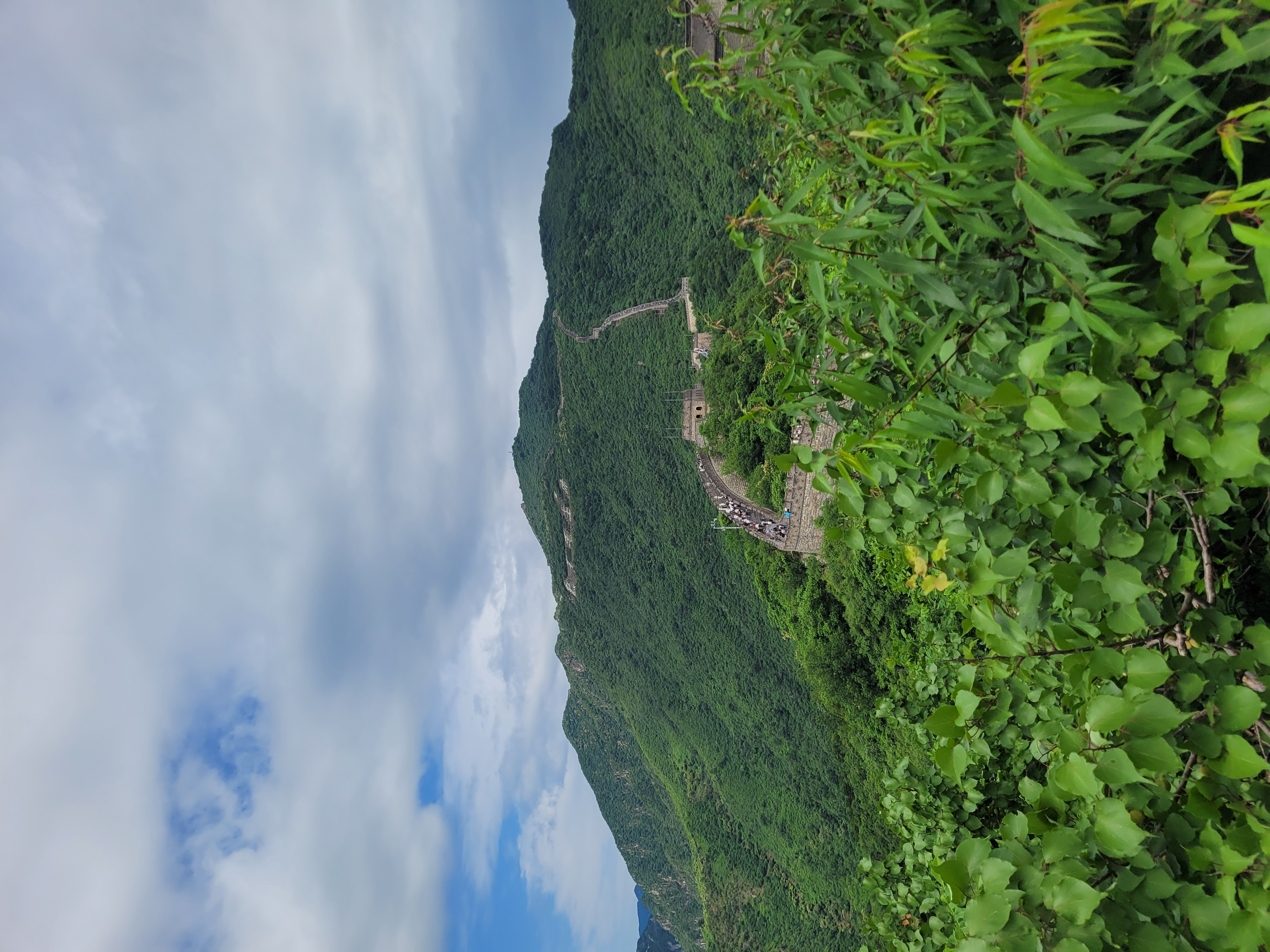 Once we got away from these feline felons, I was finally able to focus on the fantastic scenery that surrounded us. In my opinion, no picture can truly do the experience of being there, at the Wall, justice because the architecture and design are practical in nature. There are no fineries, frills, embossments, or engravings. No statues, no jewels, no precious minerals, and no paint. It is simply a giant block of cold stone and concrete designed for one clear purpose: to keep intruders out.
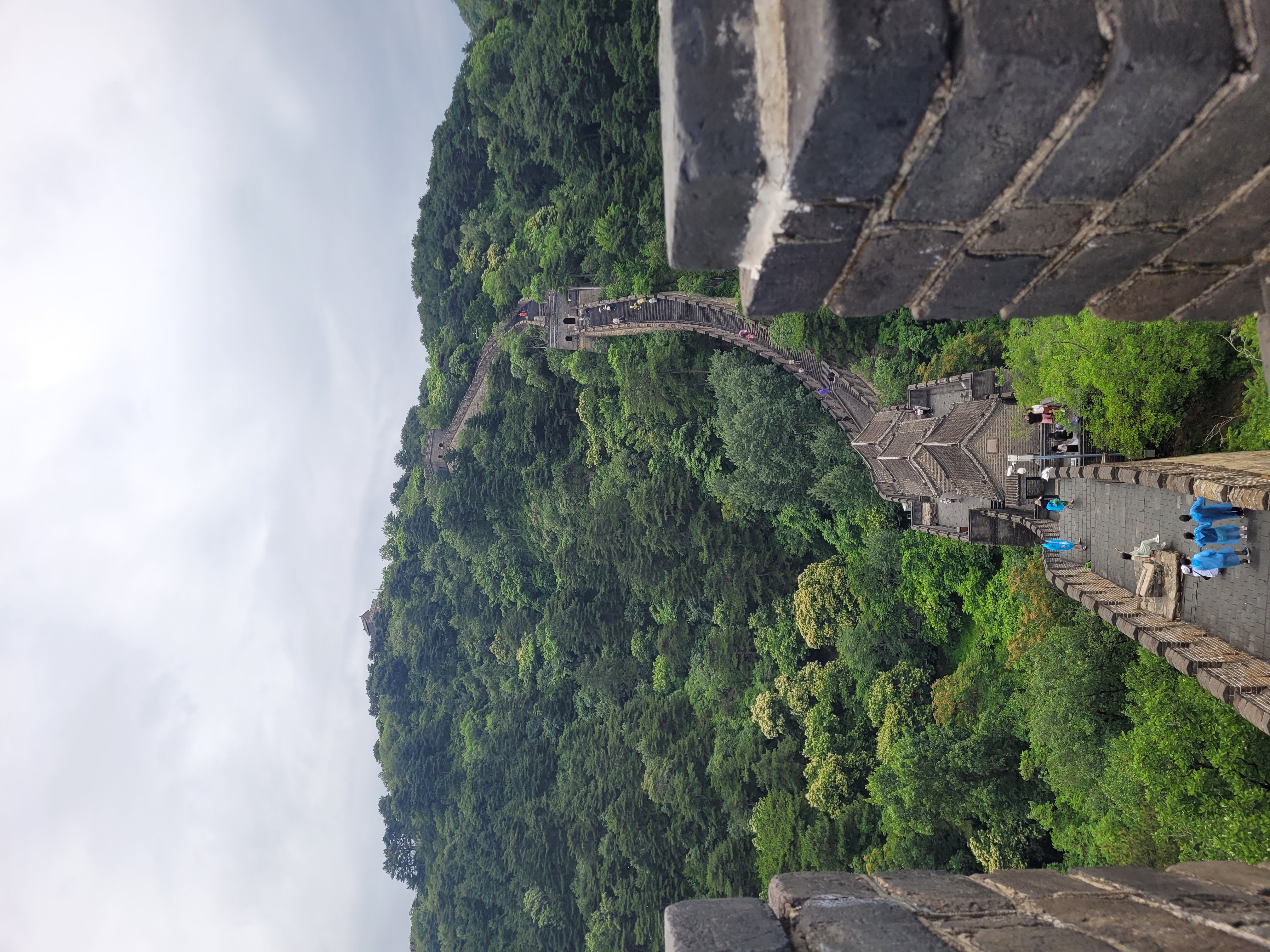 It's the context that makes it, the Herculean task of building variations on that structure for hundreds of years across the entirety of a country. You cannot fully grasp that from a picture, but when you are there and able to get a full lay of the land, you understand that every single link in this chain was the dedicated lifelong task for so many individuals. You imagine the strain that each push forward must have caused, thousands of monumental struggles buried directly beneath your feet. You feel the weight of that history all at once, and that is what makes it awe-inspiring.
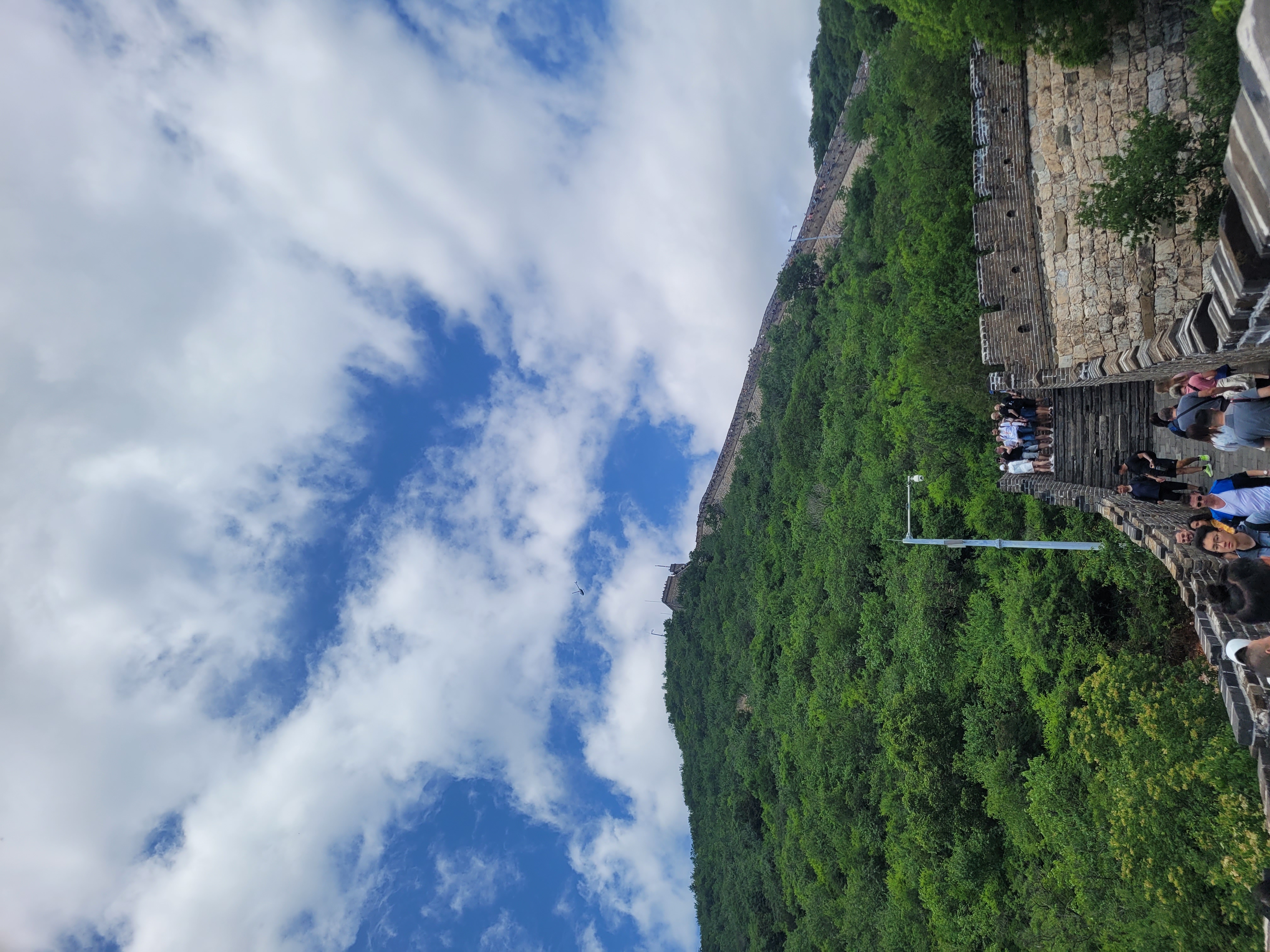
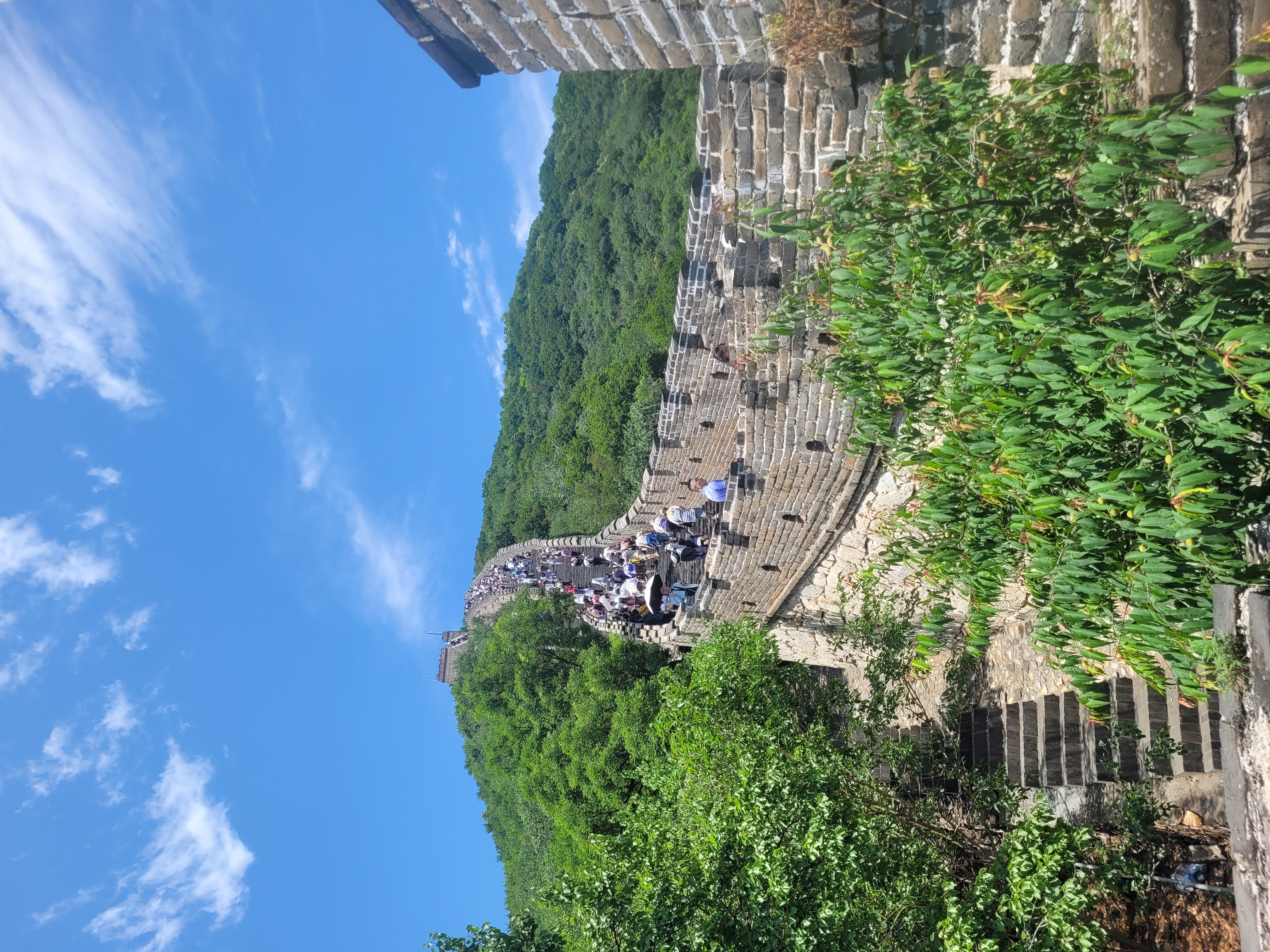
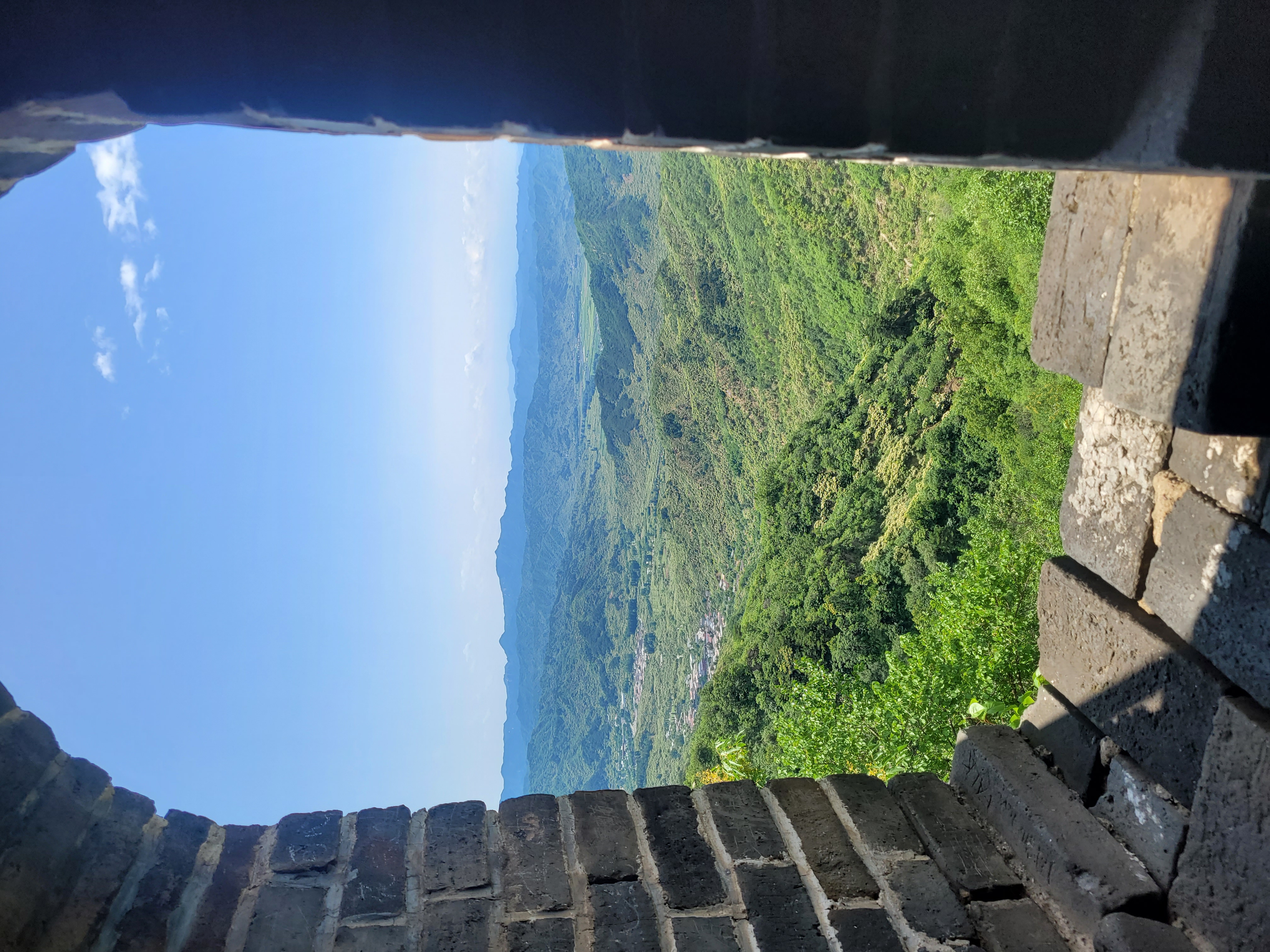
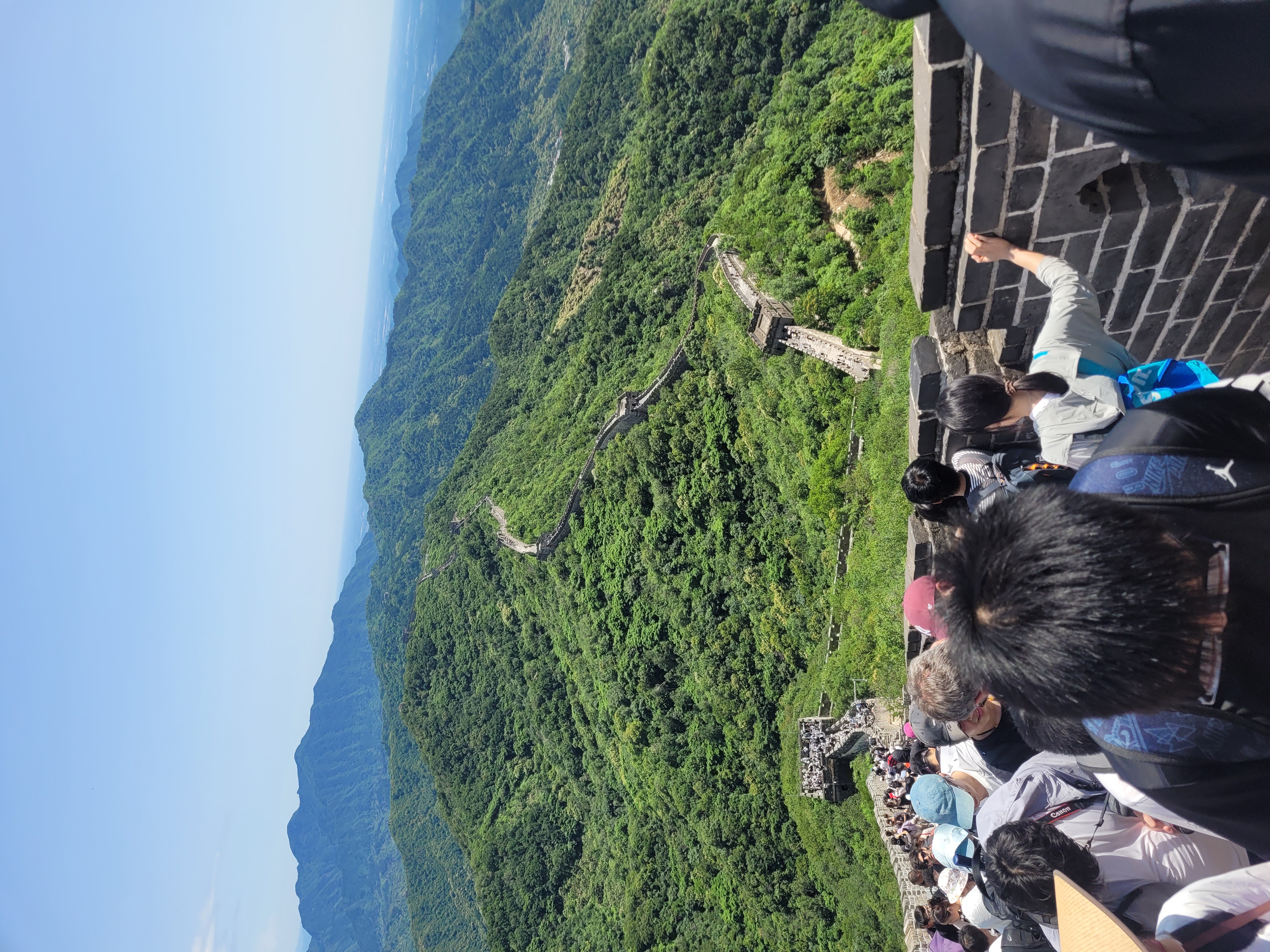 We capped off our trip to the Great Wall by climbing up to the highest point of our section, Watchtower 20. The lead-up to that point is known as the Hero’s Slope and for good reason. Initially, it doesn’t seem like a particularly intense climb, but as you get further and further up, the intensity increases until it crescendos at the final stairway to the tower. You first notice that it's a long way down. If you fall, there is nothing to catch you, so you would tumble down each and every single step until you crash into Watchtower 19 with a crunch and a thud, because despite this being a very tourist-y section, the actual architecture is unchanged. So your hands start to clam up, and simultaneously, you feel a strain in your calves and quads. You’ve been walking miles at this point, and this final push is hard. Any initial energy you had is long gone, and thus, the only thing pushing you forward is your desire to reach that peak. Frantic steps quickly turn slow and deliberate. The wall itself starts to narrow, and everyone crowds into each other, but unlike the subway, there is no bumping or shoving or jostling. Caution has endowed every individual with perfect manners because they all looked backward and down and came to the same realization. Everyone is lock-step now, up one stair at a time, slowly but surely. You’re almost there now, you see the final set of stairs, but they may as well be a ladder. They are at a 75* Angle, each step is tiny, and everyone on them is holding on to the giant stone railings for dear life. Now it's your turn, a deep breath, one last bit of courage, and then you’re there. You’ve finally reached the top, and the view, well, I’ll let it speak for itself…
Research on Legal Liability
After the tragic events I talked about in last week’s blog post, it should be relatively unsurprising that the family is seeking justice against Character.ai via a civil lawsuit. This week, I focused on Garcia v. Character Technologies Inc. It’s the kind of lawsuit that, in all likelihood, will show up in a legal textbook ten to twenty years from now. The case is still ongoing, but it's really the first of its kind and will inevitably be looked at when establishing the common law around AI Chatbots.
Firstly, how should liability work? From a personal moral standpoint, if you asked me: “What should Character.ai be liable for?” My answer would be “Yes.” However, the law does not run on righteous moral indignation(no matter how justified); it runs on practical analysis. So, an analysis of how to apply liability requires looking at how the technology works and figuring out what the company does and does not have control over. This analysis is going to be very boiled down, so apologies in advance to any legal experts reading this.
Firstly, Section 230 of the Communications Decency Act(legislation that shields online platforms from being liable for the actions of their users) does not apply to AI Chatbots as they are the ones generating the outputs, thus they are on the hook to some extent. So the next question is whether or not AI chatbots are a product or a service.
U.S. Courts typically do not categorize “ideas, information, words, expressions, or concepts as products,” meaning that, at least in Florida, the actual outputs of a chatbot would not be a product and thus strict liability would not apply. That doesn’t mean there is zero liability; it simply means that they have to prove Character.ai was negligent. The problem is that it requires showing a lack of reasonable care on a new technology where that standard is not clearly established, the technology is often difficult to explain, and the amount of control the company has over each individual output is dubious. Far from unwinnable, but it requires time, money, experts, and having to then explain all that in as clear a format as possible. So, strict liability claims are far more preferable because it is a simple chain of cause and effect: Was there a defect? Was that defect the direct cause of the harm?
Luckily, two cases do provide examples of how digital platforms can be considered products. Brookes v. Lyft Inc. and T.V. v. Grindr, LLC, both cases focus on the design of the application itself rather than the actions of the users, the “tangible medium” that contains those ideas. For Lyft, it was the distracting design of the app, and for Grindr, it was the lack of age verification. Both were design choices of the application, not actions of the user; thus, they counted as products, and strict liability could apply. In case it's still not making sense, think about it like this:
Scenario 1: You have a DVD, you watch what's on it, and it causes you harm.
That is not a product, so it is not strict liability.
Scenario 2: You have a DVD, it's so sharp you cut yourself while picking it up.
That is a product, so there is strict liability.
This legal logic then ports over to social chatbots remarkably well. AI Developers lack direct control over individual outputs, as things go through it becomes a black box even for them, and no two results will ever be identical, so strict liability does not make sense in this context. However, they do have control over things like age restriction, reporting mechanisms, the anthropomorphic design, an inability to exclude indecent content, and certain consistent behaviors the program engages in(See Examples in Last Week’s Blog). The harm may have directly come from Setzer’s interactions with the chatbot, but those interactions “were only possible because of the alleged design defects,” meaning those defects are legally considered a product and thus strict liability applies to them. This makes the argument Garcia’s legal team has to make to show that Character.ai was liable for anything that falls in those categories.
Now, there’s a lot more that Senior District Judge Anne Conway goes over in her order responding to the Defendant’s Motions, which also have a lot of larger implications, but I just wanted to provide you with this little vertical slice of my analysis. If you want to read the order, here is a link to all 49 pages: here
As always thanks for reading,
Logan Smith