

Week 4: "Feels Like Summer"
Long before Ernest Hemingway found success, he found bankruptcy. A string of poor financial decisions, bad investments, and all the classic blunders. The kind that the adventurously(or brashly) minded stumble upon while barreling forward at a speed too fast to miss whatever root, shale, or other miscellaneous stumbling block they are about to slip over before their impromptu heart-to-heart with the ground. Later in his life, he would reflect on those financial mistakes and summarize them in a single, slightly sarcastic yet fairly poignant conversation: “How did you go bankrupt?” “Two ways, Gradually and then suddenly.”
This one line outlines the framework of life’s greatest mistakes and disasters far better than I could ever hope to. Calamity is wily; it has a way of sneaking up on people, and it all starts with those minor, undetectable screw-ups. Sometimes they even feel like the right thing to do in the moment, but regardless, it all adds up. A spigot with the valve left slightly ajar, drip drop, slowly but surely filling up the bucket below until that last droplet breaks the surface tension and it all spills over.
What we are seeing with users’ rights follows this exact same process. Further encroachments on our privacy via the collection of more and more data. Further control over our lives is taken by algorithms designed to hook users and keep them on the line for as long as possible, allowing the owners of these digital platforms to control what you see and hear. The introduction of mass-market AI chatbots is not unique; it simply marks a further push forward. A few more lines crossed, a little more control gained, and most people are none the wiser. Our director used the analogy of boiling frogs; an animal unaware of the rising heat until its flesh begins to bubble and burst.
This week, I presented a seminar on the research I’ve been doing on social chatbots. You’ve already heard the specifics in my previous posts, so this week I want to stay focused on this general theme I’ve just presented to you, but before that, let’s start with a personal excerpt.
Travel Log
My seminar went well; I was able to present a well-researched topic that people were interested in, engaged with at length, and get a real discussion going. The problem was I was so worried my throat was going to dry out that I drank a metric ton of water. Slamming back one crummy paper cup after another, small enough that I didn’t feel like I was drinking too much water, but by the end, my stomach was churning. I was experiencing some form of water intoxication, which led to this truly miserable headache. So I resolved to drink significantly less water the next day so my body could reach some form of equilibrium. Surely after drinking all that water, I’d be fine to go a while without it.
 A heatwave had just hit Beijing, the sun scorched the pavement, creating a haze that drifted above the asphalt, the heat index came out at a blistering 105°F, and most people had retreated to enclosed spaces with fans and AC units on full blast to ward off the ever-encroaching warmth. However, with only 90 days in Beijing, taking a weekend off would be giving away far too much valuable free time. So Alex, me, and our coworkers resolved to go to the zoo. Even as we arrived, I felt a slight pang of pain on the brim of my forehead, but it was quickly drowned out by my excitement.
 Ever since I was a little kid, I’ve loved zoos. If I had to state a particular reason why I’d say it's because it represents as close of a chance to really observe wild animals from across the world as an average person can get. You can only really get a true sense of scale and that feeling of them actually existing by seeing them in person. Numbers and images given form, inches and feet go from vague estimates to definitive, shockingly large shapes. When you can look them in the eyes and glimpse how they observe you, see the gears turning, and wonder what they could be thinking. It does a far better job of satiating my curiosity’s appetite than reading or watching ever could. First-hand accounts shaken through a sieve turn into second-hand retellings, which are then fractured by our own perspectives and experiences. All of it is like one bad game of telephone, so when the opportunity arises, I’ll always take any chance to cut out the middleman and simply see it myself.
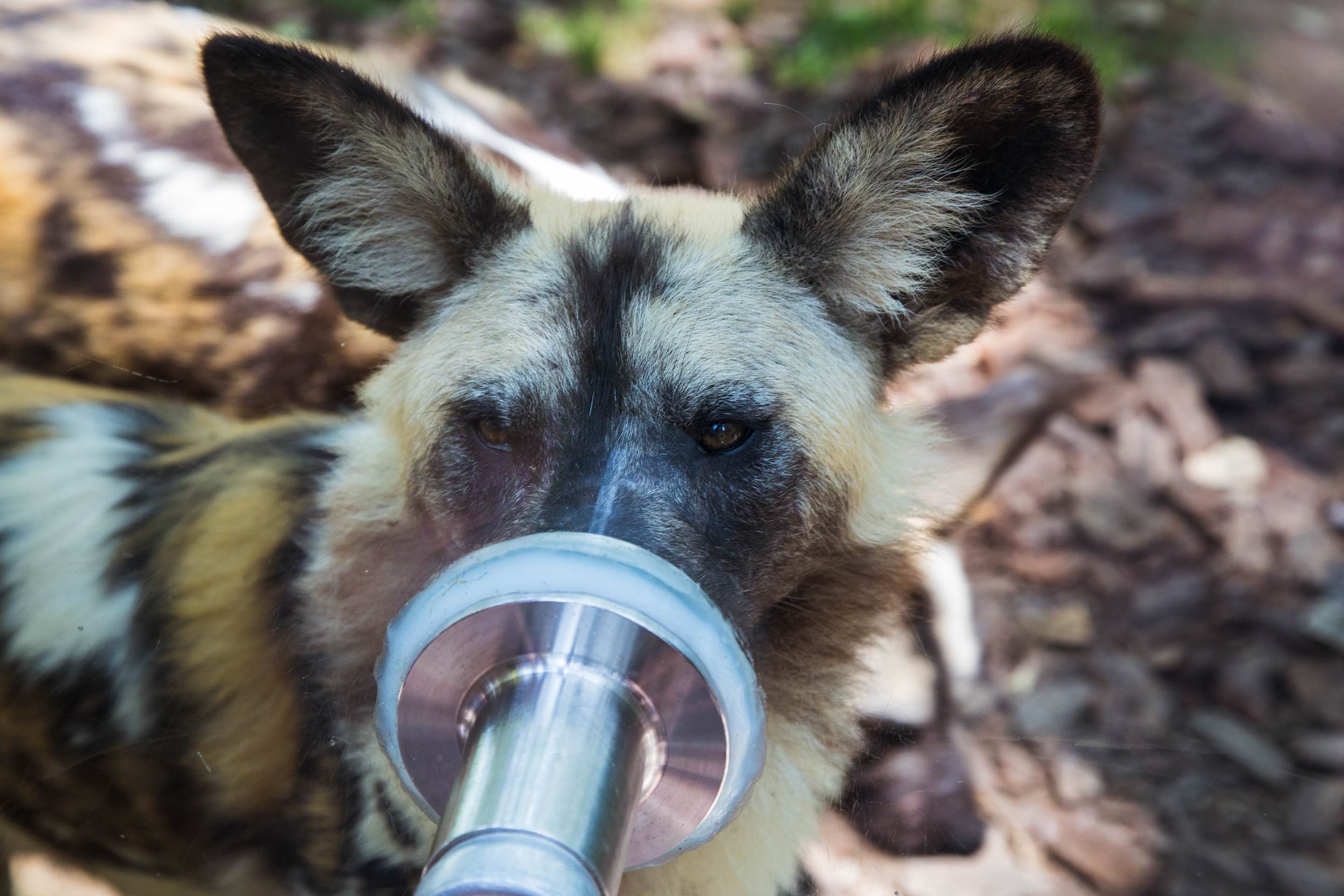 Zoos also reflect their creators. By visiting a lot of them, you can compare and contrast to spot things like practical concerns, regional differences, and their culture’s view on our shared natural world. For example, at this zoo, there was a lot in common with zoos back home, such as a safari section you could drive through, but it was far larger to accommodate the increased population. You had people zooming around in what were essentially tricked-out golf carts made to look like various animals. You were also able to feed a lot of the animals through this sort of glass opening. I got the chance to feed an African Wild Dog(one of my favorite animals), it was really incredible, and in general, the design of the zoo felt like it was a lot more willing to allow visitors to get up and close with a lot of the wildlife.
  Some particular highlights include the lemur enclosure, which was set up like an aviary, with the animals out lazing about on the rocks within arms lengths, the red panda enclosure with a similar design, the meerkats had these open air mounds, and lastly the capybara exhibit was this series of steam cloaked pools where you could actually get up on the rocks and actually pet them. It was all really incredible. The selection of animals was different as well. The funniest example was that they had a raccoon on display, something that to me was entirely unnoteworthy, which was an attraction halfway across the world.
 Beyond any semi-pretentious pontificating, zoos are simply good fun. Running around with childlike excitement on a blistering hot day brings a feeling of nostalgia. Distant memories of field trips long since passed, bubbling up to the surface. It all makes it easy to get sucked in, to feel like you’re in a world entirely different then your own, to… oh right I needed to drink more water.
Thump, Thump, Thump. We’ve just gotten out of the hall of reptiles. Thump, Thump, Thump. Every step causes another jolt of pain that hits like a percussive beat. Ba-da-bump, Ba-da-bump, Ba-da-bump. The sun is setting, things are cooling down, we’re leaving the park, but the pain is worsening, quickening. I can feel that I’m on the edge of dehydration. It's happened to me before: your body loses so much water that you start getting sick, losing more and more water, and then that feeling of panic starts creeping up. I realize that of all the places I want to visit in China, a hospital is not one of them. Not due to any concerns over the quality of care, but because the disorientation combined with the pain would be so uniquely miserable.
However, I don’t have time to think about that because as soon as the thought enters my mind, it's cut out by the pain, which inserts itself into the right side of my face like a dagger. We finally reached our destination. I can’t think, I can barely move. I’m completely disoriented. It’s like I can feel my body shutting down all at once. Thankfully, my coworkers were there with me. They were able to get me some painkillers and something to drink, and slowly but surely, I was able to drag myself back from that edge. If they hadn’t been there, it would have been a complete disaster. I can’t thank them enough for saving me that day. In fact, the worst part about dealing with chronic migraines isn’t the pain; it's the fact that I never have the words to express my gratitude for the people who were there for me when I needed them the most. That day was another painful lesson in how small, mindless mistakes can lead to colossal, excruciating consequences.
The Snowball Effect
In the lead-up to the seminar, there was one clear question that kept bouncing around in my head: “What value do I provide this firm?” A lot of that came from the feeling of impostor syndrome because this was my first job, but I was also thinking about it from a pragmatic point of view. What do they gain from taking on interns who often have little to no practical experience when they have enough high-level connections to every industry they may be interested in? After doing my seminar, I think I’ve come to a definitive answer to that question: “A Unique Perspective.”
 Our director has been heavily focused on creating a global network of lawyers to face the shared legal issues that are arising due to users’ rights and the ever-growing importance of digital platforms. By sharing ideas, approaches, and issues, they’ll be able to be at the forefront of this ever-growing legal field. However, that also requires studying and understanding new technologies, and that intersection we exist, the international intern. Our value, in my opinion, is providing insights on novel topics that may arise from our personal interests in said technology that they may otherwise not have found out about.
For me, that interest was chatbots. Originally, my research was going to be on how ChatGPT was aiding the rise of a mass cheating epidemic, but while looking into that, I noticed the far more interesting thread of social chatbots. So I pulled on that thread, and as I dug up more, I was able to keep unravelling this larger issue. At this point, I’m finally able to see the bigger picture and present it to other people.
The fight for users’ rights is a war of awareness and information. Technology is advancing at such a pace that the general public is unable to learn about and react before it becomes a significant problem. Every individual infringement is small enough to go mostly unnoticed right until the point that it isn’t. Let’s again look at chatbots as an example.
As previously mentioned, chatbots are sycophantic by design. This is done to create a frictionless interaction for the user, and on its own, that would be fine, good design even. The problem is that this fills a desire for easily consumable social interaction, which causes people to go to the chatbot more and more, and they stay engaged for longer periods of time. This high engagement leads to more significant and valuable data collection. So they hit the gas on the feature because why would you ever hit the brakes? They take this process further, creating social chatbots that directly market to that appeal, with none of those pesky “practical uses” getting in the way.
Occasionally, somebody crosses a line too far, too fast, like ChatGPT did in April of this year(link), but for the most part, people don’t realize they are talking to an AI that, with each passing day, believes more and more that every idea the user has is solid gold. This is not healthy, talking to the world’s best Yes-Man, 24/7, seven days a week, poisons the mind, it kills a person’s critical thinking skills, and enables their worst behaviors. In severe cases, this leads to perfectly healthy individuals going from fine to having full-on mental health episodes in an exceedingly short period of time. (link) However, far too many people write them off as simply predisposed to disaster while ignoring the growing underlying issue that led to these extremes in the first place.
Dear readers, some of the more skeptical among you may believe that I am being an alarmist. Screaming and hollering about edge cases, pretending that Skynet is just around the corner, standing in the way of technology that can truly change our world for the better. I understand where you are coming from, and I want to make it clear that your takeaway from this blog should not be “AI BAD.” This technology has great potential to be used for good. Next week, I’ll be exploring those uses, but at the rate this technology is advancing, we need to approach it with extreme caution. It is the fundamental incentives behind their designs that slowly but surely get stretched into these grotesque logical extremes. So there is a need to sound the alarm about concerning features now lest they slip underneath our radars. We need to capture the butterfly because we will be utterly helpless in the face of the hurricane it brings in its wake.
The truth is, the impact this blog has will be microscopic at best, but hopefully the work I’m doing will at least pique your curiosity. The key things I want you to take away from this blog are that your data and your attention are quickly becoming more valuable than any other natural resource on the planet, and digital platforms are exploring every single avenue to acquire as much of it as possible as fast as possible. They do not care about the potential harm this has and will cause. If you want a clear example, Google acquihired Character.ai(the company whose app was heavily tied to Sewell Setzer III’s death) for 2.7 billion dollars in October of last year. (link) If this behavior is left unchecked, it will continue to lead to severe real-life consequences. Your best shield against it is awareness, it's understanding what they are doing with your data, how they are attempting to hold your attention, and how that can directly affect you and the people you care about most.
As always, thanks for reading.
Logan Smith