Week 1
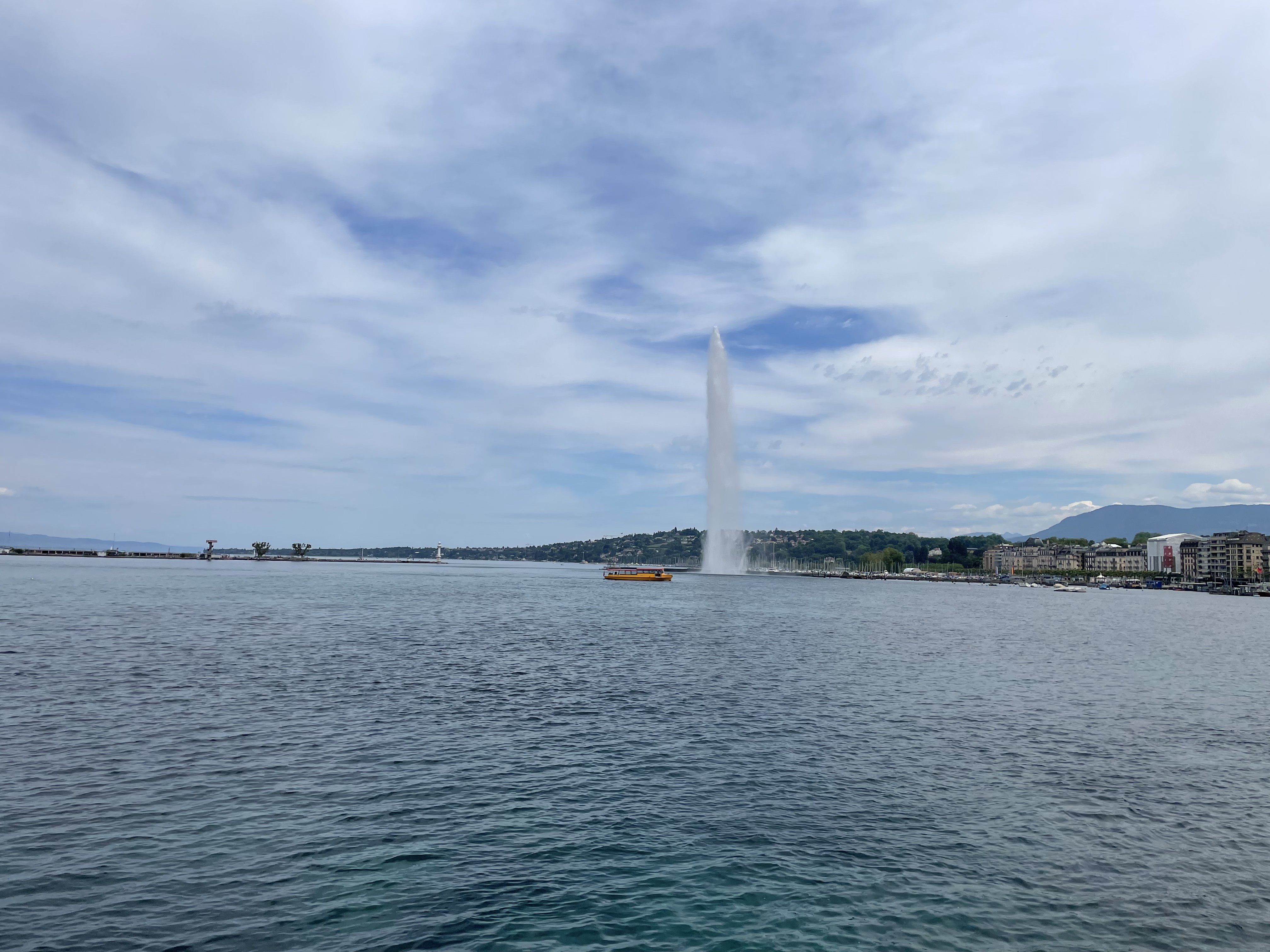
Crystal blue waters, lush parks, alpine views. It doesn’t get much better than summer in Geneva.
The city swaddles the southwestern end of Lake Geneva, known in local parlance as Lac Léman. Although the lake is surrounded by towns, its waters are an uncanny turquoise, transparent to the lake bed. Monstrously sized swans drift along the currents. It’s all too perfect.
The lakefront is my favorite stretch of Geneva. I’ve been in the area only a week, but I’ve already spent hours tracing the pedestrian path, soaking up the sun and trying to glimpse the summit of Mont Blanc across the horizon. I guess the iconic, towering Jet d’eau is cool too.
There is more to Geneva than the lake, of course. It’s just the aspect of this area I will miss most when I leave, and therefore feel most inclined to mention first in my introduction to the city.
---
This summer I am interning at Global Survivors Fund (GSF), an NGO that partners with local organizations around the world to provide reparations to survivors of conflict-related sexual violence (CRSV). GSF was founded in 2019 by Dr. Denis Mukwege and Nadia Murad, winners of the Nobel Peace Prize in 2018. While there were already organizations working to improve the welfare of CRSV survivors, either through advocacy or by providing services such as medical/mental health care, no organization existed to provide reparations when states could not or refused to do so.
Reparations are important in the context of CRSV because international law recognizes the right to reparation as a remedy for grave violations of international human rights and humanitarian law. (To be clear, CRSV constitutes such a violation.) Notably, the duty to provide reparations rests with the perpetrator of the violation. Because perpetrators are often state actors, governments of many countries bear the responsibility of redressing the life-altering losses that CRSV survivors incurred at their hands.
Reparations may take the form of monetary compensation. State funds earmarked for this purpose often do not make it to survivors, either because the government has not established a mechanism to disburse the funds or because the mechanism that is set up is impossible for survivors to navigate.
GSF addresses the reparations gap. It helps local organizations to provide interim reparative measures until governments are able to provide the compensation or services to which survivors are entitled. For example, in 2024, GSF partnered with the Association of Detainees and Missing Persons of Sednaya Prison (ADMSP) to support survivors of Syrian detention now living in Türkiye. GSF helped to provide the relief that the survivors indicated would be most helpful: financial compensation. Many survivors used their funds to start businesses or to pursue educational opportunities.
I am excited to work at GSF not just because I appreciate its mission but also because it strives to ensure that its work is survivor-led at every stage of its work. I look forward to learning more about the process of tailoring reparative measures to a specific culture, political context, and people.
More to come next week.