

William & Mary Law School Leads in Preparing Students for Ethical Use of AI
As artificial intelligence (AI) continues to reshape industries and redefine professional workflows, William & Mary Law School—America’s first law school—is taking bold steps to prepare its students for the future.
Recognizing both the promise and pitfalls of AI, the school has launched classroom and research initiatives to equip future Citizen Lawyers with the skills and ethical grounding needed to navigate an AI-driven legal landscape.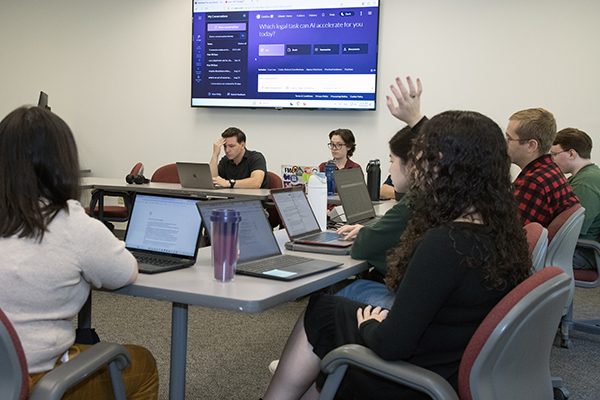
“Professional education leaders must consider at least three measures to ensure the relevance of their programs,” said Dean A. Benjamin Spencer in a July 2023 HigherEdDive op-ed. He emphasized integrating such AI-related skills as data analysis and machine learning into curricula, supported by technically proficient faculty and industry collaboration. He also stressed the importance of teaching students to use AI as a tool to enhance their professional impact, and the need to instill ethics and professional standards for client-facing roles.
These ideas were already in motion in spring 2018, when the Law School introduced “Artificial Intelligence & More: Legal Issues Likely to Arise from AI & Related Technologies,” a course funded by the Silicon Valley Community Association (supported by Cisco) and developed by Professors Iria Giuffrida and Fredric Lederer (William & Mary) and Professor Nicholas Vermeys (University of Montreal). The course, whose content evolves with the many developments in this domain, explored the broader AI ecosystem and its implications for legal professionals.
For students like Molly Lovell J.D. ’18, the experience was transformative. “I want to be one of those attorneys who embraces new technology, and this class has taught me to do that,” she said.
A number of seminars and conferences soon followed. Under the aegis of the prestigious Reveley Fellowship, Giuffrida collaborated with Chon Abraham of William & Mary’s Mason School of Business to develop an interdisciplinary seminar “Cyber and Information Security Essentials.”
The two schools also partnered to host a cybersecurity conference titled “Cyber Intrusion, A Conference of Experts.” The Law School has also worked with other on-campus partners such as the Whole of Government Center of Excellence, the Department of Computer Science, the Global Research Institute, and many others.
In Fall 2023, Laura Killinger, Director of the Law School’s Legal Practice Program and Clinical Professor of Legal Writing, launched “Incorporating ChatGPT in Legal Writing,” a short course for upper-level students. Initially skeptical of generative AI, Killinger created the course she wished had existed. “I capped it at 20 students, hoping for maybe 10,” she said. “It filled up in five minutes.”
Now in its fifth semester, the course covers prompt engineering, ethical considerations, editing, and the limitations of tools like ChatGPT. Students learn how Generative AI can support legal writing, overcome writer’s block, and serve as a study partner. One key takeaway: small changes in prompt wording can lead to dramatically different outputs, highlighting the need for precision and critical thinking.
Killinger also integrated AI instruction into the first-year legal writing curriculum, reinforcing the school’s belief that responsible AI use is central to legal practice.
The Law School’s Wolf Law Library has also embraced AI’s impact on legal research. “From the first rumblings about AI, we perked up,” said Leslie Street, Clinical Professor of Legal Research and Director of the Wolf Law Library. “I started keeping a folder of stories five years ago.”
Street noted that incoming students often arrive with digital fluency shaped by AI tools. But law school is different. “What worked before won’t work the same way here,” she said.
Students learn that legal research isn’t just about finding something relevant—it’s about finding a comprehensive answer relying on clear legal authority. “Without foundational skills, AI becomes a dangerous shortcut,” Street said. “We teach AI alongside the structure and context of legal information.”
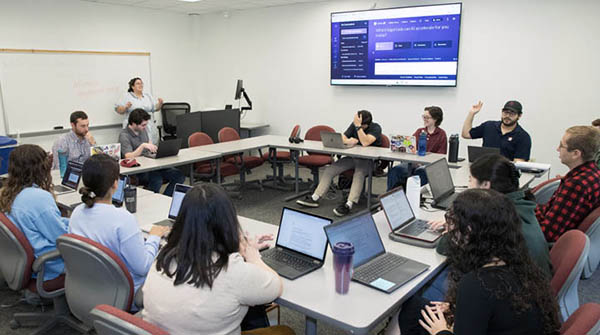 As students advance through law school, they encounter increasingly sophisticated uses of AI. In both 1L and upper-level courses, faculty emphasize that legal research and legal analysis are inseparable—neither can be done well without the other.
“We add more sophisticated skills in upper-level courses, for example we may utilize AI in drafting more complex legal documents,” said Street. “But we stress the importance of substantive research to ensure accuracy, jurisdictional relevance, and completeness.”
Students also learn how to craft effective prompts, interpret AI-generated results, and—most critically—verify the information they receive. Street notes that even the most advanced tools can hallucinate or interpret real authority incorrectly. Librarians, with their expertise in information literacy, reinforce a vital lesson: AI is only as reliable as the data it’s trained on.
“We ask students to consider: Is the training data current? Does it include session laws and administrative codes, or just outdated statutes? Often, we don’t even know what data the tool uses,” Street says. “That’s why we embed information literacy into AI instruction—not as a separate topic, but as a core part of legal research education.”
With the Bar Exam now testing legal research directly, this instruction is more urgent than ever. “Students who rely solely on AI won’t just struggle in practice—they may not pass the bar,” Street said. “We teach them to use AI wisely, critically, and always alongside the skills that define great lawyers.”
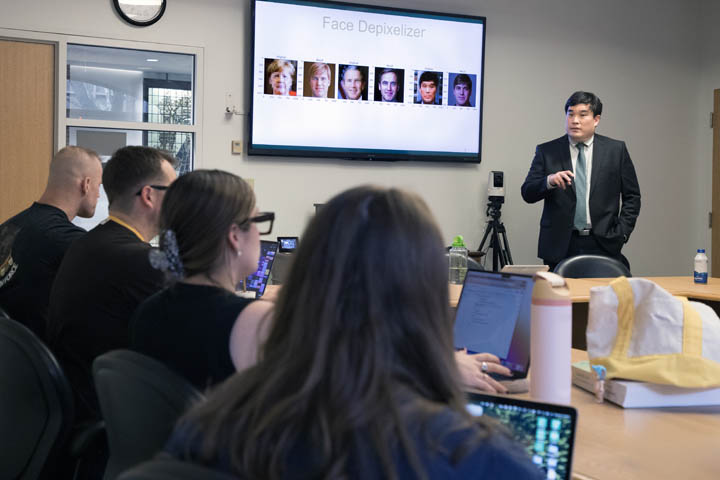 The Law School has also expanded its tech-focused curriculum, which now includes, alongside "AI & More" taught by Professor Giuffrida: "AI Law & Policy" (Professor Margaret Hu); "AI: An Introduction for Non-Experts" (Adjunct Professor Daniel Shin); "AI, Cybersecurity, and Data Privacy" (Adjunct Professors Elizabeth Waller and Ross Broudy); "Applied Data Privacy" (Adjunct Professor Taylor Treece); "Cybersecurity Incident Response" (Adjunct Professor Holly Brady); "Cryptocurrency Regulation" (Professor Eric Chason); "Technology-Augmented Trial Advocacy" (Professor Fred Lederer); and "Technology & Crimes Against Children" (Adjunct Professor Peter Osyf). Many more courses explore smart contracts, autonomous vehicles, and Fourth Amendment implications.
AI is also the centerpiece of conferences and symposia. The Center for Legal and Court Technology’s (CLCT) ongoing “Problematic AI” series, most recently held in February 2025, draws experts from academia, government, and industry. These free hybrid events feature panels on predictive analytics, legal liability, and ethical AI use, and the next Problematic AI conference will be held on March 13, 2026. The Center also hosts courtroom simulation workshops using AI tools, VR, and 3D evidence presentation, with tailored sessions for law firms and courts.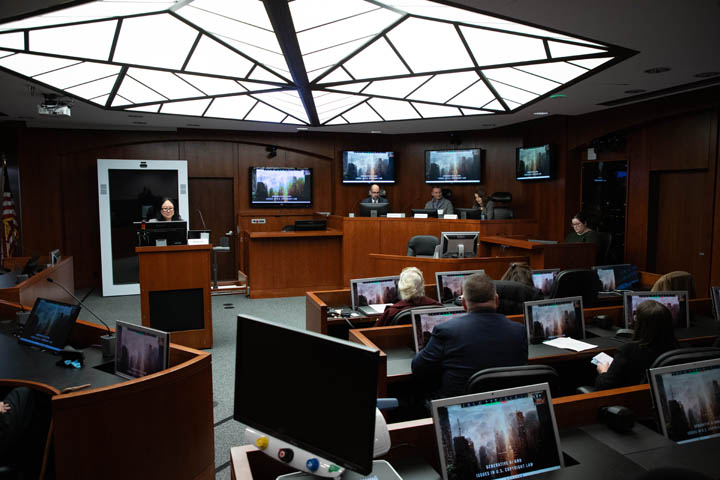
Students gain hands-on experience through partnerships like one with legal tech startup Anytime AI, founded by William & Mary alumnus Lingfei “Teddy” Wu. The company provides free access to its AI legal assistant platform, enriching student learning and faculty research.
Faculty scholarship, too, continues to shape national conversations. Professor Margaret Hu, a national voice on civil rights, surveillance, and AI, has testified before the U.S. Senate more than once, most recently in June before the full committee of the U.S. House Committee on Oversight and Government Reform. In August, she authored AI Law and Policy (Aspen, 2025), a leading 1,100-page casebook in the field that quickly became the #1 best-selling new release in Amazon’s “Internet and Computer Law” category.
Interdisciplinary research thrives as well. The Center for Digital Democracy hosts events on election security and AI policy, and CLCT received a grant to study AI in legal decision-making. Professor Laura Heyman co-led an NSF project on accountable software systems and co-authored several articles, one of which was the recipient of an ACM SIGSOFT Distinguished Paper Award. Professors Giuffrida and Shin co-authored an article with colleagues from the Department of Computer Science that was presented at the IEEE Symposium on Security and Privacy 2025 in San Francisco.
Guest speakers bring global perspectives, and events like a September 12 AI Bootcamp, “The Future of Legal Training,” led by Clarion AI Partners, help faculty and staff stay ahead with best practices.
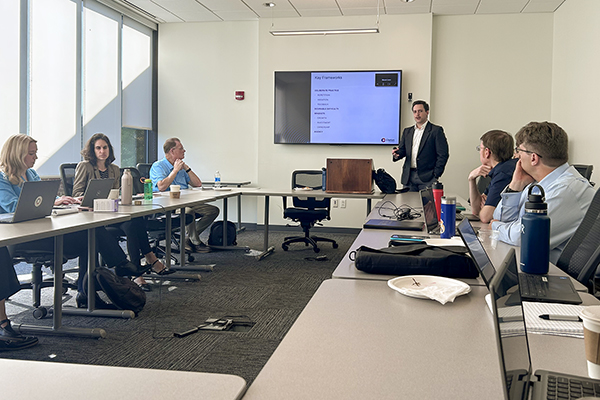 As AI evolves, the Law School remains committed to preparing students to lead with integrity in a rapidly changing legal landscape. Dean Spencer recently tasked Laura Killinger and Leslie Street to form an AI working group that develops recommendations for updating the curriculum to ensure students gain essential competencies in using generative AI.
The group's mission is to explore best practices and propose ways to incorporate instruction on legal practice applications of AI throughout the JD curriculum. This involves studying approaches adopted by other law schools, assessing the strengths of the Law School’s own curriculum, and identifying appropriate opportunities to integrate AI instruction that will prepare students for the evolving demands of legal practice.
“Responsibly managed AI-assisted work is vital to upholding professional standards,” said Dean Spencer. “By proactively integrating AI into legal education and addressing its ethical implications, our Citizen Lawyers will thrive in an AI-driven world.”