

Breaking bread and building community: Faculty enrichment program brings new ideas and perspectives to legal research
Rigorous and impactful legal scholarship doesn’t arise in a vacuum. It emerges from critical engagement and collaboration with other scholars, both inside one’s own institution and beyond. And sometimes, it requires a good meal.
William & Mary Law School has perfected this recipe with its Faculty Enrichment series.
Known officially as the Elmer J. Schaefer Workshop Series, the program features speakers from William & Mary and other law schools, giving presenters an opportunity to present their work and engage in rigorous scholarly discussion. Paper topics and formats vary widely, from journal articles to book chapters, with attendance limited to William & Mary faculty and invited scholars.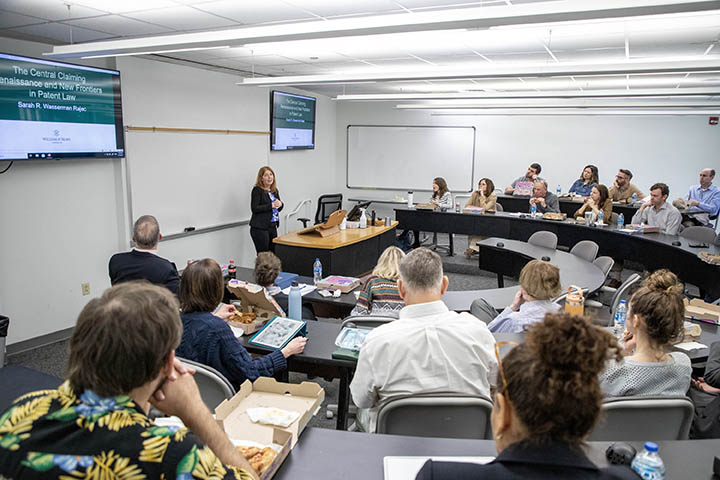
“We try to have representation from lots of different fields of law,” said Evan Criddle, Associate Dean for Research and Faculty Development. “These are people the faculty would like to meet and interact with. When selecting speakers, we give preference to nominations from our junior faculty, offering them a chance to build relationships with senior scholars working in their areas of interest.”
The workshop series traces its origins to its namesake, Professor Emeritus Schaefer, remembered as a dedicated and innovative teacher whose research focused primarily on antitrust and business regulation. At Schaefer’s retirement in 2002, William & Mary Law Professors John E. Donaldson and Charles H. Koch, Jr. praised Schaefer for his “enlivened discussions in the faculty lounge” and for being “a positive force in the intellectual life of the law school,” whose “insightful questions and pertinent suggestions ... helped enhance the level of scholarship of the law school faculty.”
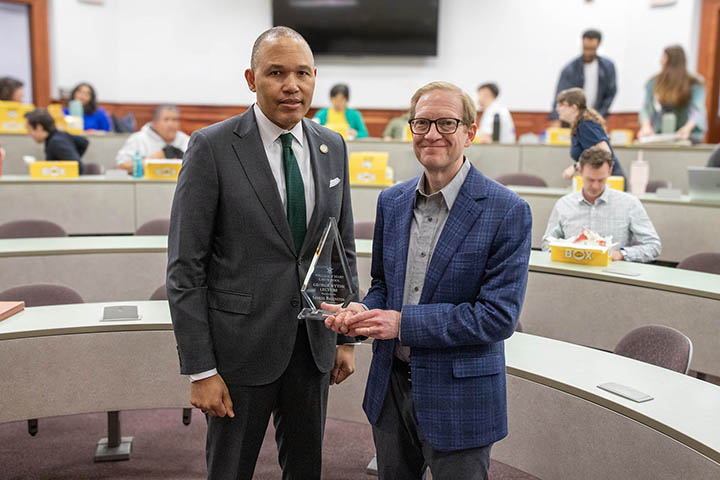 What began as a program weighted toward internal faculty presentations shifted gradually toward speakers from other schools. More recently, organizers have made a deliberate effort to restore a balance between internal and external presenters, ensuring that more William & Mary faculty members have the opportunity to share their scholarship with colleagues at the Law School.
There’s also a personal touch built into the process: the faculty member who nominates a speaker typically takes them to dinner, an informal gesture that helps forge connections between institutions. Speakers have included co-authors presenting joint work, as well as occasional guests from outside academia, including judges and practicing attorneys.
The relationships formed through these workshops aren’t just one-directional. Visiting speakers often invite William & Mary faculty to their own conferences or workshops, extending the network in both directions.
“A conversation over lunch before or after a talk can spark a collaboration that might never have happened otherwise,” Criddle said. “And with each visit, the series quietly reinforces the Law School’s reputation as a place where serious scholarship is taken seriously.”
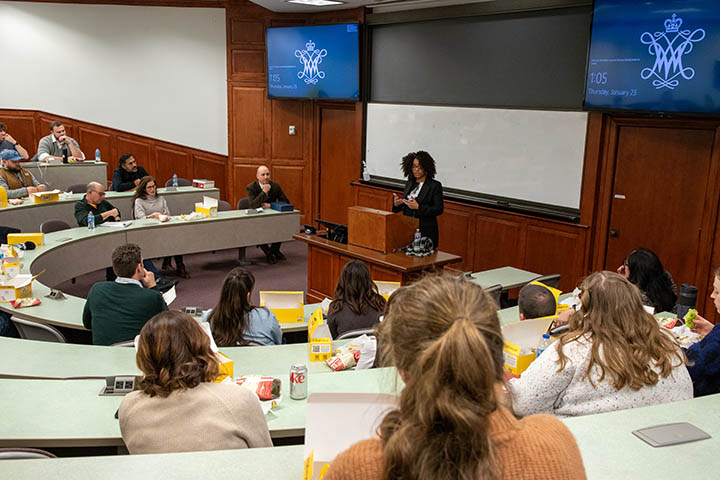 Talks in the series are explicitly framed as “works in progress,” an invitation for real, substantive feedback rather than polite applause. That framing shapes the culture of the room: questioning is rigorous and challenging, meant to sharpen the work rather than simply praise it. Because the sessions are closed to outsiders, presenters can speak candidly about ideas still taking shape, without worrying about how a half-formed thought might read outside the room.
“Talks are typically 15 minutes, and the conversation with attendees that follows is typically about 35 minutes,” Criddle said. “That conversation is often considered more valuable than the formal presentation itself. The format is designed to feel less like a classroom lecture and more like breaking bread with colleagues.”
In the end, that may be the series’ quiet achievement: turning the solitary work of scholarship into something communal. A workshop can’t guarantee a better argument or a sharper footnote, but it can contribute to ensuring that no idea at William & Mary Law School has to develop in isolation. Over three decades after Schaefer first helped shape that culture in the faculty lounge, his name still marks a program where ideas are tested and refined over a shared meal.