

Brigham-Kanner Conference Brings Property Scholars to London, Honors James Penner
“And so to London,” poet Louis MacNeice wrote in Autumn Journal (1939). Eighty-seven years later, the William & Mary Property Rights Project followed suit. View the slideshow.
The journey saw property scholars and practitioners from three continents gathering in London October 14–16 for the 23rd annual Brigham-Kanner Property Rights Conference. The program included presentation of the 2026 Brigham-Kanner Property Rights Prize to James E. Penner, the Kwa Geok Choo Professor of Property Law at the National University of Singapore. Learn more.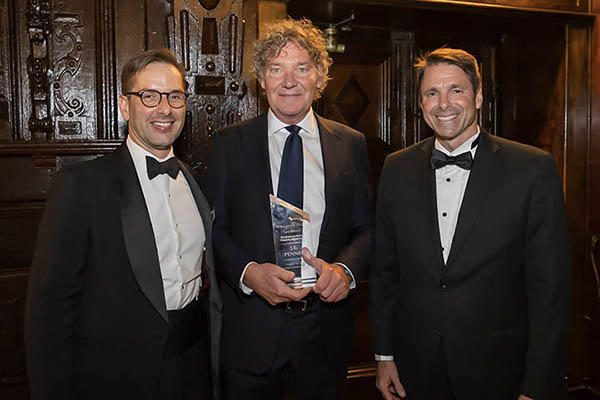
The conference opened Wednesday evening with a reception on the Terrace Pavilion of the House of Commons, hosted by the Right Honorable Baroness Butler-Sloss and sponsored by Katie and Joshua Baker ’06, managing partner of Waldo & Lyle, P.C.
“It is fitting that an event sponsored by William & Mary Law School should meet here in Westminster,” said John Brownlee '94, Vice Rector of William & Mary’s Board of Visitors. “William & Mary was founded in 1693 by a royal charter of King William and Queen Mary, making it the United States’ second-oldest college, and serves as a constant reminder of the special bonds between our two countries.”
Raul Madden, Lecturer in Law at Queen Mary University of London, welcomed guests on behalf of the host institution. “It is true that for centuries Parliament has shaped the meaning of ownership and how we experience it,” Madden said. “Few places have a longer and more impactful relationship with the subject of our conference.”
 Andrew Prince Brigham, senior partner of the Brigham Property Rights Law Firm and chair of the conference’s advisory council, described the gathering as an extension of its fellowship across the Atlantic.
“We are here because we’re celebrating property,” Brigham said. “We are looking at its architecture; we are looking at it from a policy basis; we are looking at it from the practice of law and representing people who own property. This is tremendous for us as Americans to come over and to be inspired."
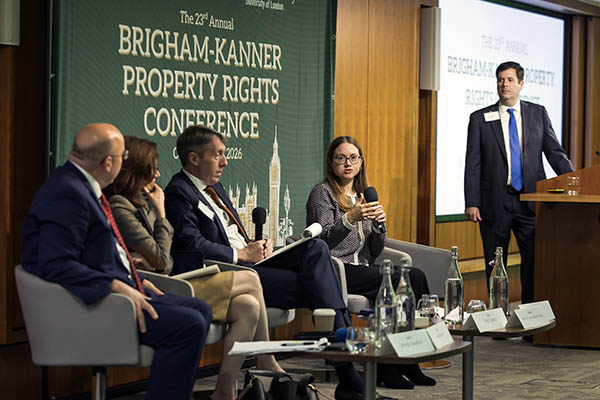
Over the next two days, seven panels at No. 11 Cavendish Square took up questions ranging from the nature of ownership to compensation for government takings, with English law and legal history running throughout.
William & Mary Law Dean A. Benjamin Spencer opened Thursday’s sessions by promising “a dynamic day of insightful panels, lively discussion and opportunities to connect with thought leaders from around the world.”
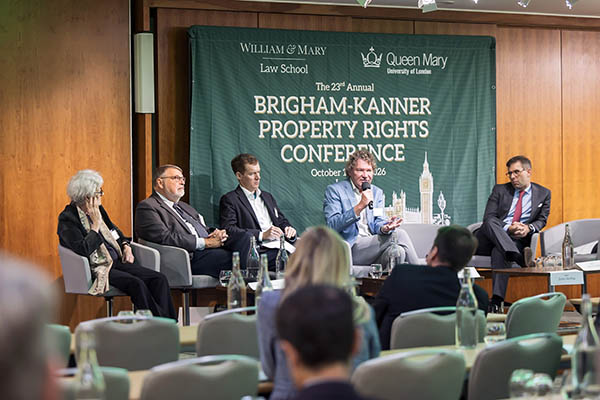 The first panel turned to Penner’s own scholarship, which has reshaped how lawyers and theorists understand the nature and structure of property. Moderated by James Y. Stern, director of the Property Rights Project, the panel examined Penner’s account of property in separable “things,” the role of exclusionary norms, and his place in the long-running bundle-of-rights debate. Penner was joined by Ben McFarlane of Oxford, Thomas W. Merrill of Columbia, Henry E. Smith of Yale, and Carol M. Rose, professor emerita at Yale and the University of Arizona. Panelist James Burling of Pacific Legal Foundation was unable to attend the panel, but thanks to the conference organizers, contributed his thoughts on Penner’s work the following day. Watch the video.
The second panel turned to “other people’s things”: trusts, corporate and charitable entities, and fiduciary arrangements that split control from benefit. Raul Madden, Paul B. Miller of Notre Dame and Irit Samet of King’s College London discussed what separating legal and beneficial interests means for the idea of ownership. Blake A. Willis ’18 of Waldo & Lyle, P.C., moderated. Watch the video.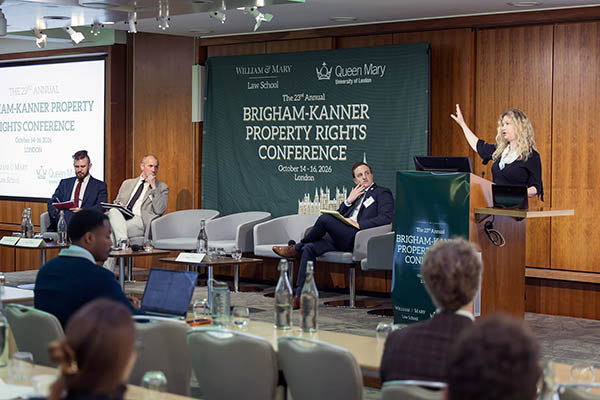
After lunch, a panel moderated by Joseph T. Waldo ’78 took property into the international arena, weighing its status as a human right, its relationship to state authority, and how investment law and interstate dispute resolution shape domestic property systems. Panelists were Thomas Allen of Durham, Gregory H. Fox of Wayne State, Eric Loefflad of Exeter and Robert H. Thomas, the Joseph T. Waldo Visiting Chair in Property Rights Law at William & Mary. Watch the video.
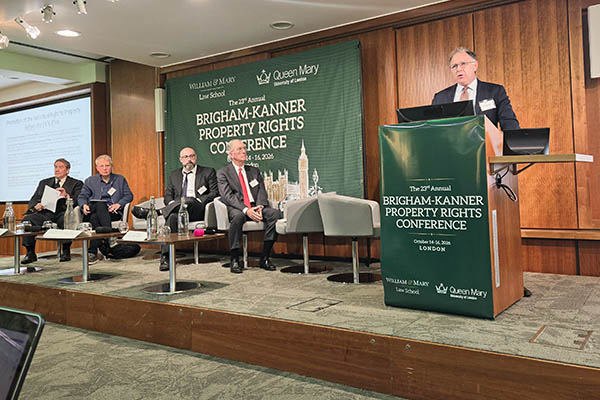 The day closed with a look backward. Sir John Baker of Cambridge, Maureen E. Brady of Harvard, Claire Priest of Yale and Randall A. Smith of Smith & Fawer explored how Roman and English sources continue to shape property law, and the uses and limits of history in modern doctrine. Brett S. Tensfeldt ’16 of the Brigham Property Rights Law Firm moderated. Watch the video.
Friday began with intangible property in an interconnected world. Danielle D’Onfro of Washington University, Justin Hughes of Loyola Law School, Los Angeles, and Christopher K. Odinet of Texas A&M considered how intellectual property and digital assets strain territorial assumptions built for land and goods. The session was moderated by Cody S. Taylor ’28, William & Mary’s Toby Prince Brigham Property Rights Fellow, who also served on the conference planning committee, a clear example of the school’s Citizen Lawyer ideal in action, with a current student helping to shape, not just attend, an international gathering of leading scholars. Watch the video.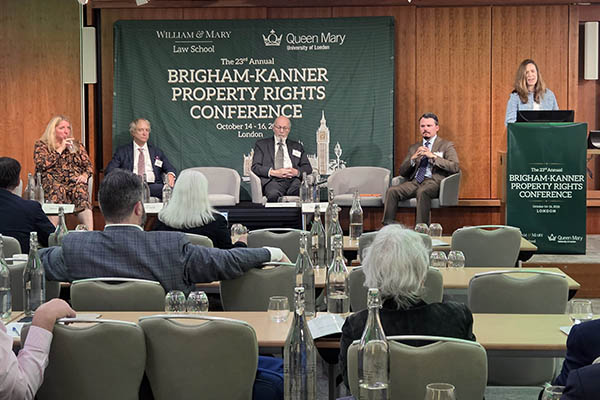
A comparative panel on compensation for government takings followed, setting English, American and Canadian law side by side on when compensation is owed and how it is measured. Moderated by Brigham, it brought together David L. Callies of the University of Hawaii, Raj Gupta of Town Legal, Gregory Jones KC of Francis Taylor Building and KBW Chambers, and Shane Rayman of Rayman Barristers. Watch the video.
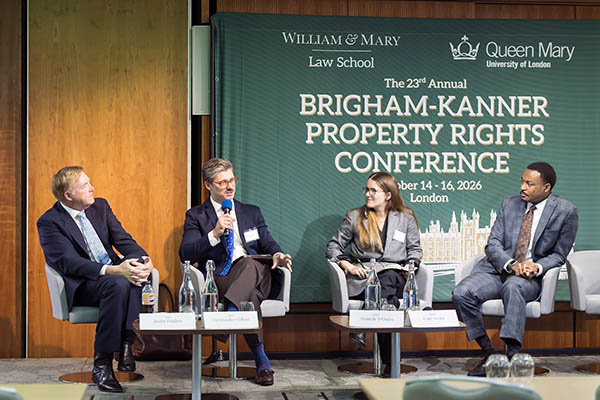 The final panel returned to first principles. Under the banner “Of Locke, Bentham and Blackstone,” Eric R. Claeys of George Mason, Jeremy P. Hopkins ’02 of Cranfill Sumner, Larissa M. Katz of the University of Toronto and Laura Biron Scott of Balliol College, Oxford, traced how labor, productivity, security and legal order underpin modern ideas of ownership, and where those English thinkers part ways. Joshua E. Baker ’06, managing partner of Waldo & Lyle, moderated. Watch the video.
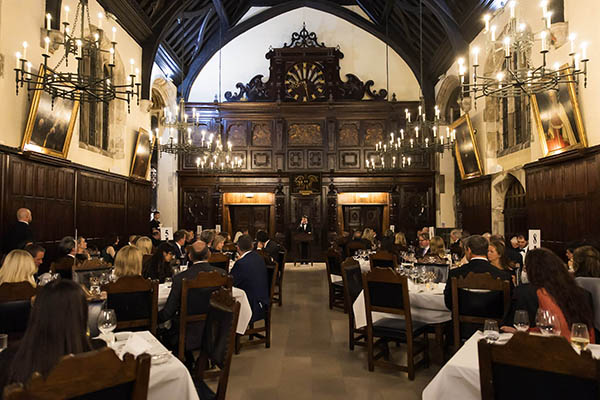
The conference culminated Friday evening with a dinner in the Old Hall of The Honourable Society of Lincoln’s Inn, where Penner formally received the prize.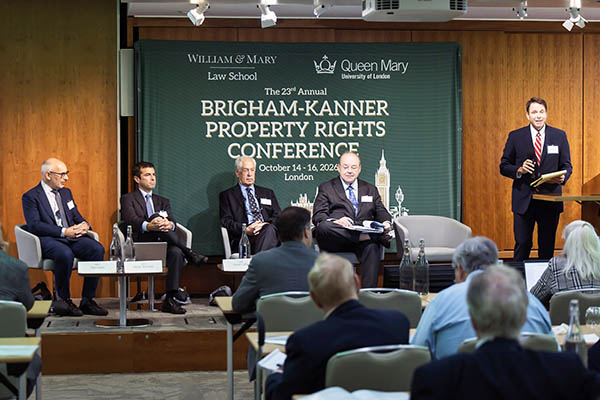
“James Penner has reshaped how we understand the very idea of property, influencing practical accounts of how property works, philosophical accounts of its moral foundations, and legal doctrines that shape its operation on the ground,” Stern said. “The Brigham-Kanner Prize is a fitting tribute to Professor Penner for his extraordinary contributions to our appreciation of what property is and does.”
Penner accepted with characteristic humility. “I hope that my work has in some way touched people’s lives, helped inspire them to do work, helped inspire them to criticize me,” he said. “The wonderful thing about the academic world is that people come up with ideas that you should have come up with yourself. And it keeps you thinking.”
He closed with a paraphrase of philosopher Jerry Fodor on the academic life: “The work conditions are questionable, the money is no good, but you do get to meet some interesting people.”
 The evening also marked a passing of the torch for the annual conference, as Professor Stern announced that Josh Baker will succeed Andy Brigham as chair of the conference’s advisory council, a role Brigham has held for several years.
Participants said their goodbyes Saturday morning at a farewell breakfast at The Welbeck Hotel in Marylebone, the conference hotel. See more in the slideshow.
Penner joins a distinguished list of Brigham-Kanner Prize recipients: Frank Michelman, Richard Epstein, James Ely, Margaret Jane Radin, Robert Ellickson, Richard Pipes, Carol Rose, Sandra Day O’Connor, James Krier, Thomas Merrill, Michael Berger, Joseph Singer, Hernando de Soto, David Callies, Stewart Sterk, Steven Eagle, Henry Smith, Vicki Been, James Burling, Gregory Alexander, Lee Anne Fennell and William Fischel. Learn more.
About the Brigham-Kanner Property Rights Conference
The Brigham-Kanner Property Rights Conference brings together members of the bench, bar and academia for panel discussions with vigorous audience participation. It was founded in 2004 through the initiative of William & Mary Law School alumnus Joseph T. Waldo ’78, who served as co-chair from 2004 to 2017; in 2018, the Joseph T. Waldo Visiting Chair in Property Rights Law was named in his honor.
The Conference, Prize and Journal, are named in recognition of Toby Prince Brigham (1934-2021), founding partner of Brigham Moore LLP, and Gideon Kanner (1930-2023), Professor of Law Emeritus at Loyola Law School in Los Angeles, for their lifetime contributions to private property rights and their efforts to advance constitutional protection of property.
Sponsored by William & Mary Law School since its inception, the conference has grown increasingly international, meeting at Tsinghua Law School in Beijing in 2011 and at the Grotius Centre for International Legal Studies in The Hague in 2016.
To learn more about the William & Mary Law School Property Rights Project and the Brigham-Kanner Property Rights Conference, please visit our web page.