

Koch Administrative Law Forum Examines the Fallout of Trump v. Slaughter
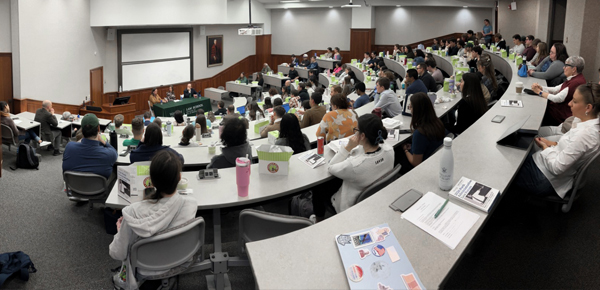
On November 10, William & Mary Law School’s Institute of Bill of Rights Law (IBRL) hosted its annual Koch Administrative Law Forum, named for the late Professor Charles H. Koch. This year’s forum examined the U.S. Supreme Court’s decision in Trump v. Slaughter (2026). It featured the case’s plaintiff, former Federal Trade Commission (FTC) commissioner Rebecca Slaughter, in conversation with Allison Orr Larsen, William H. Cabell Professor, Alfred Wilson & Mary I.W. Lee Professor of Law and director of the IBRL, and Jonathan Adler, Tazewell Taylor Professor of Law.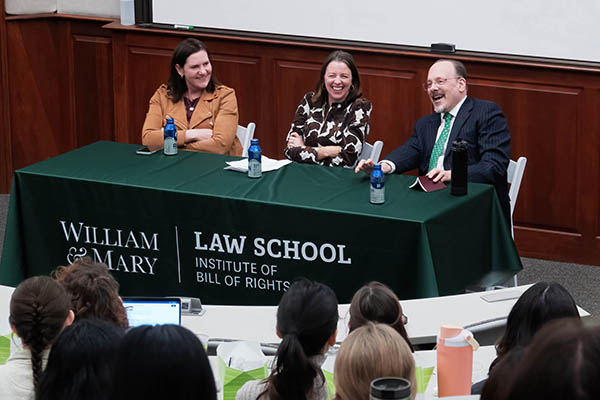
“It’s not every day you get to hear from a named party in a landmark Supreme Court decision, and we are thrilled we provided that opportunity to our students at this year’s Koch Forum,” Larsen said. “Our conversation with Rebecca Slaughter and Professor Adler offered a rare look into administrative agencies and the law that governs them at such a pivotal time of change for our country.”
Denise Koch HON '21, founder of the forum and Professor Koch’s wife, provided opening remarks, and said that late husband was devoted to the study of administrative law and would greatly appreciate the discussions. “The issue of the unitary executive and the scope of executive power are top of mind today, and Ms. Slaughter was the perfect panelist to shed light on the realities of this issue,” Koch said. “I am very thankful to Professor Larsen and the IBRL for continuing to sponsor these important conversations.”
 Slaughter’s dismissal from the FTC in March 2025 led to the Court’s landmark ruling that the president may remove FTC commissioners without cause. The decision overturned Humphrey’s Executor v. United States (1935), which had allowed Congress to restrict the president’s power to fire the heads of independent agencies, including the FTC. The Court in Slaughter reasoned that because Article II vests all executive power in the President, officers who execute the law must be removable at will to remain accountable to him.
Many legal observers see the decision as a vindication of the “unitary executive theory,” which Adler explained to the audience. “When we talk about the unitary executive theory, we’re talking about how much power—however much there may be—is under the complete control of the president,” he said. “One interpretation of the first line of Article II of the Constitution is whatever executive power there is, it is all ultimately in one place.”
Slaughter said she is not a proponent of the unitary executive theory. “There is no agency of government that exists on its own,” she said. “They are given life by statutory structure and construct, and I think the structure of an institution is as important to its function as the substantive mandate that it has.”
The panelists also discussed Trump v. Cook (2026), decided the same day, which upheld for-cause removal protections for members of the Federal Reserve Board. As a result, President Trump could not immediately remove Governor Lisa Cook while the dispute over his stated cause continues.
Both Slaughter and Adler found the Court’s distinction between the FTC and the Federal Reserve hard to justify. “I cannot find the part of the Constitution that says Article I, Article II, or Article III asterisks monetary policy,” Slaughter said, adding with a laugh, “if you smart law students work really hard to understand something and you cannot understand it, the problem is not you.”
The discussion closed with the practical problems that could follow from Slaughter, starting with how commissions will keep functioning once members can be fired at will. Slaughter suggested quorum rules as one way to restore bipartisanship, though she noted that some agencies lack them. Adler pointed to a larger gap: none of the multi-member commissions with removal protections are subject to the Federal Vacancies Reform Act, so appointments to them require Senate approval. That is a higher hurdle for the Trump administration after Democrats’ resounding wins in the 2026 midterm elections.
“The Trump administration has hinted at wanting to argue that certain aspects of the Federal Vacancies Reform Act might be unconstitutional, and that there might be an inherent executive authority to fill positions on a temporary basis,” Adler explained.
“Should a president’s party not control the Senate, the president’s choices for independent boards and commissions might be people with whom they entirely agree, or no people at all. And that is not a tenable way to govern,” Slaughter said. “In his concurrence in Slaughter, Justice Gorsuch argued that we should not assume that Congress would have delegated these powers to be under the direct control of the president, and so therefore, maybe they just shouldn’t have those powers at all. That would excise an important part of governmental function, but we may end up there.”
“That may be a good topic for next year’s Koch Forum,” Larsen remarked.
About the Koch Administrative Law Forum
Charles H. Koch was a national leader in administrative law and the author of the multi-volume treatise Administrative Law and Practice. He held several leadership positions in the Administrative Law section of the Association of American Law Schools, was active with the administrative law bar, and took a keen interest in the European Union, foreseeing its growing importance to global and domestic law.
Denise Koch and her son, Andrew, created the forum in his honor. It grew out of a March 2013 symposium honoring Professor Koch, and past forums have included “Administrative Law in Transition: Changes to Expect in the Biden Administration” (2021), “The Vaccine Mandate & Administrative Law” (2022), and “RIP Chevron” (2024).
About the Institute of Bill of Rights Law
Founded in 1982, the IBRL is committed to educating the public about the Bill of Rights. Guided by the conviction that bringing together experts from diverse disciplines deepens our understanding of constitutional issues, the Institute provides a forum for debating matters of law and policy.