

Podcasters Sarah Isgur and Kate Shaw visit William & Mary Law, present two views of the Supreme Court
Within three weeks this fall, William & Mary Law School hosted two of the country’s best-known legal podcasters, each offering students a different lens on the Supreme Court and the Constitution.
Sarah Isgur, host of “Advisory Opinions” and editor of SCOTUSblog, visited on Friday, September 25. Kate Shaw, a University of Pennsylvania Carey Law School professor and co-host of “Strict Scrutiny,” followed on Thursday, October 15. Both events were hosted by the Institute of Bill of Rights Law (IBRL), continuing its tradition of bringing prominent commentators, journalists and scholars to campus.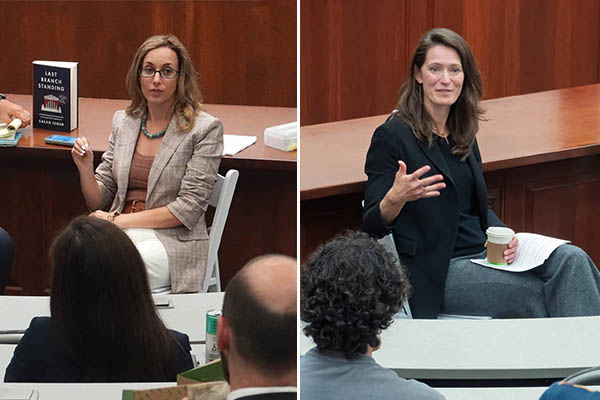
Isgur spoke about the Court as an institution, one she sees holding the constitutional line. Shaw focused on the Court’s growing influence over how Americans vote. The two conversations gave students rare chances to hear the Court examined from across the ideological spectrum.
Isgur came to discuss her new book, “Last Branch Standing: A Potentially Surprising, Occasionally Witty Journey Inside Today’s Supreme Court” (Crown, 2026). The title reflects her central thesis that the Supreme Court is the one branch of government the founders would still recognize. As she told the moderator, Professor James Stern, the court tries to hold a constitutional line as executive power has grown and Congress has legislated less. The book has been described as a myth-busting look at what the public gets wrong about the Roberts Court, with ideas for repairing a court in crisis.
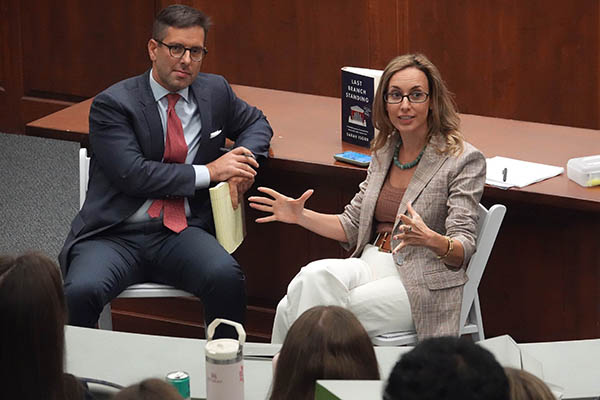 Asked about her pitch to her publisher, Isgur emphasized humility as a way to bridge political divides. She wants readers of every political stripe to reflect on a time they were wrong. Having friends across the aisle, she said, is a sign of intelligence, kindness and intellectual humility.
Three weeks later, students heard Kate Shaw discuss election law and the growing role of courts in shaping how Americans vote. The event was co-hosted by IBRL and the Election Law Society, the student-run branch of the Election Law Program. Shaw’s scholarship and public commentary regularly sit at the intersection of law, democracy and the Supreme Court, and she drew on both.
Serving as interviewer, Rebecca Green, Professor of Law and Director of the Election Law Program, opened on a hopeful note, asking Shaw to name positive court decisions from recent years.
Shaw pointed to the Court's turning away President Trump’s attempt to upend elections through the Postal Service, though she warned a similar attempt could come in the 2028 elections. She also cited the three times the Court intervened to block a Republican-backed 2025 redistricting map from taking effect in Missouri.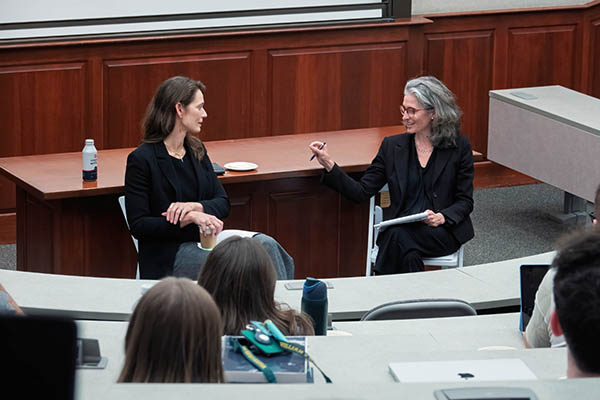
The conversation then turned to what Professor Shaw saw as more concerning turns for the Court when it comes to election law: the hollowing out of the Voting Rights Act, the apparent shift to condoning partisan gerrymandering, and the new presumption of good faith that applies to legislative redistricting.
During the student Q&A, one student asked how to get involved politically. Shaw noted that law schools tend to emphasize the federal level, but said local work is just as important and fulfilling.
The two visits offered students contrasting starting points. Isgur, who clerked for Fifth Circuit Judge Edith H. Jones and led public affairs at the Justice Department, framed the Court as a steadying institution amid an expanding executive and a less active Congress. Shaw, a former Obama White House lawyer and clerk to Justice John Paul Stevens, focused on how court decisions shape access to the ballot and the health of democracy.
Yet the speakers shared common ground. Both urged students to look beyond the obvious: Isgur toward friends and ideas across the political aisle, Shaw toward legal work at the local level.
Professor Larsen, director of IBRL, had this to say about the two events: “In less than a month our students got to learn from two of the most high-profile legal commentators in the country—one from the political left and one from the political right. The fact that both guests wanted to come speak to our community says a lot about them and a lot about us.”