

Professor Sonia Katyal Discusses Intellectual Property Rights and Museum Repatriation in 2026 Mervis Lecture
Who owns the Parthenon marbles, who should own them and why does it matter?
Professor Sonia Katyal of UC Berkeley School of Law presented the 2025–26 Stanley H. Mervis Lecture in Intellectual Property at William & Mary Law School on March 30. Katyal’s lecture, “Repatriation as Prism,” explored the intersection of technology, intellectual property and civil rights—the focus of her scholarly work—through the lens of museum collections. 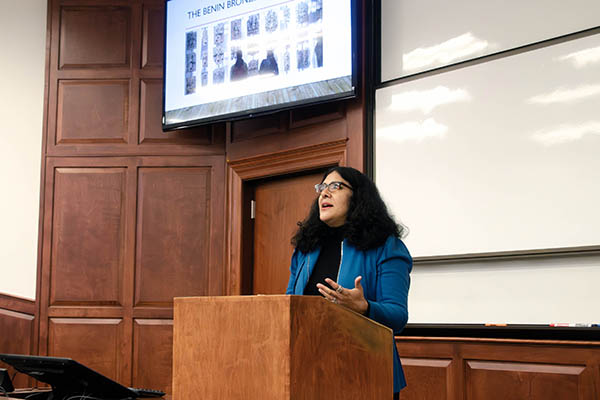
Katyal introduced the topic through the case study of “Scaffold,” a sculpture by American artist Sam Durant intended to memorialize seven different mass executions carried out by the United States government, including the execution of 38 Dakota men in Mankato, Minnesota, in 1862. In 2017, “Scaffold” was installed in the sculpture garden of the Walker Art Center in Minneapolis, where it quickly drew condemnation from members of the Dakota community. Although Durant stated that he intended for the piece to raise awareness about the troubled racial history of the country’s criminal justice system, the sculpture instead reopened wounds for indigenous Minnesotans. Durant met with members of the Dakota community and agreed to transfer ownership of “Scaffold”—both the physical structure and his intellectual property rights—to the Dakota people, who eventually decided to destroy and bury the piece.
The topic of repatriation has been at the forefront of conversations surrounding museum collections for the past several decades. In 1990, the U.S. federal government passed the Native American Graves Protection and Repatriation Act, requiring any institution receiving federal funds to return ownership of human remains and cultural artifacts in their possession to the indigenous tribes to whom the artifacts originally belonged. Museums around the world have returned art and artifacts taken during periods of colonial violence. However, questions remain about both repatriation and the intellectual property rights surrounding these works.
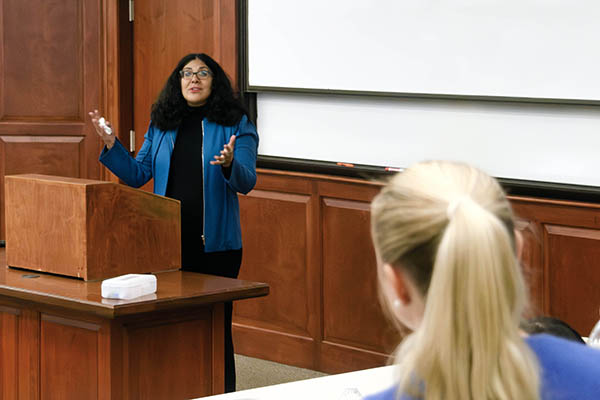 “Repatriation is not just a binary. It is not simply a ‘return’ or a ‘retain.’ Between those different poles lies a complex typology of arrangements, each with its own implications for power, for sovereignty and for healing,” Katyal said.
With “Scaffold,” the Dakota people now own the intellectual property rights to the work, and Durant is not legally allowed to recreate the piece without their permission. In other instances of repatriation, however, the question of ownership is less clear. In her lecture and in her wider work, Katyal argues that concerns over intellectual property ownership must be addressed if institutions want to avoid causing further harm to cultures and communities.
“As repatriation has changed the landscape of IP concerns, we also think that IP concerns have transformed the landscape of repatriation,” Katyal said. “In this context, IP concerns can either be a tool for further institutional redemption, or act as a proxy for illegitimate control.”
In 1986, legal scholar John Henry Merryman distilled the question of who should own cultural artifacts down to two frameworks: nationalism, where cultural heritage should be maintained by the nation of origin, and internationalism, where artifacts are housed in locations that offer the greatest access to a global audience. His support for the internationalism approach was embraced by many institutions that held themselves out as guardians and educators. According to Katyal, however, these approaches are both insufficient for the modern legal and technological environment and fail to consider cultural groups as independent agents whose needs should be considered in conversations about intellectual property rights.
The actual practice of repatriation, Katyal explained, looks much different from what Merryman imagined. She outlined eight models demonstrated by institutions that range widely in their consideration of cultural heritage and autonomy, from the full IP transfer of “Scaffold” on one end to the stance of the British Museum—which owns thousands of artifacts, including the highly contested Parthenon marbles, and is generally barred from disposing of its holdings under the British Museum Act of 1963—on the other. 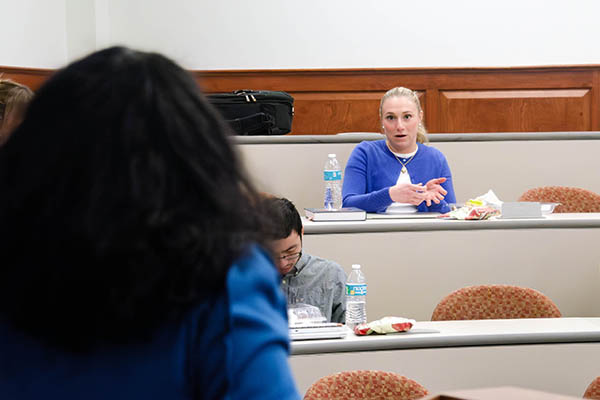
Many institutions fall somewhere in the middle: some museums return the physical objects while continuing to own digital assets, others set up a stewardship model where the objects remain at the institution but the IP rights are transferred to the cultural group or country, who then decide how the items are used and displayed.
In these evolving conversations around repatriation, Katyal said, the law can serve as either a barrier to or pathway for cultural healing and decolonization. Intellectual property experts can provide valuable insights about the best methods for reconciling the legal and moral questions around repatriation.
After Katyal finished her remarks, student Valerie Carter ’26 asked how issues of fair use and First Amendment rights intersect with repatriation considerations, particularly in cases like “Scaffold” that deal with original works. Katyal called this “one of the most insightful challenges to the scope of repatriation,” and explained that this could be an area where legal and moral priorities conflict; in those situations, fair use should probably take precedence. However, each case will have its own context that must be considered.
Another student, Leo Li ’27, asked about Katyal’s decision not to include images of “Scaffold” itself in her presentation. She explained that even though the Dakota have not requested that all images of the sculpture be removed from the internet, choosing not to include the image in her lecture is a symbolic gesture that acknowledges that the rights holders are the only ones who can decide how the work can be used—a gesture that speaks to the overall importance of clarifying intellectual property rights for items of cultural importance. 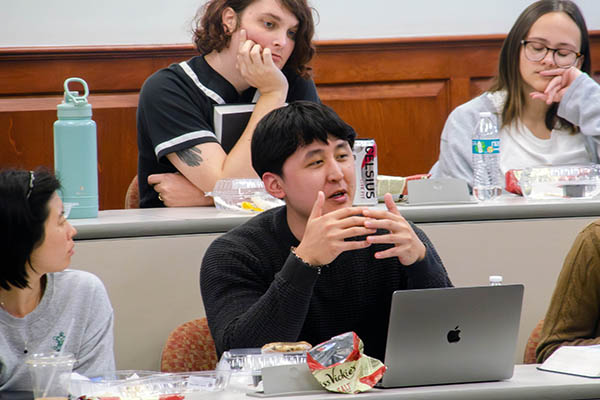
“I think that we do lose something when we lose the visuality of the artwork,” Katyal said, “but we also gain this really important sense that not all things are meant to be accessible to everyone at all times.”
While Katyal acknowledged that this can be a hard concept to accept for those who believe in the importance of access to information— herself included—she explained that one of the reasons she is drawn to the topic of repatriation is that she is “comfortable with the idea that there should be some restrictions on cultural heritage and cultural property.”
“I think that part of what it requires us to do in this very multicultural world where it’s a cacophony of different kinds of interests, is to allow for people to choose what they want to do with their intellectual property and their cultural property, and to respect that,” she said.
Katyal is the Roger J. Traynor Distinguished Professor of Law at UC Berkeley Law and Co-Director of the Berkeley Center for Law & Technology. She is a graduate of Brown University and the University of Chicago Law School and clerked for judges Moreno and Nelson on the District Court and Court of Appeals for the 9th Circuit, respectively. More information about the topic of her lecture can be found in the 2025 paper “The Spectrum of Digital Repatriation,” coauthored with Andrea Wallace and Mehtab Khan.
About the Mervis Lectureship
The Stanley H. Mervis Lectureship in Intellectual Property was created in memory of Stanley Mervis in 2003 by his family and friends. Mr. Mervis, a member of the William & Mary Law School Class of 1950, was patent counsel for Polaroid Corporation for most of his career and was actively involved in important patent and intellectual property issues.
Other notable individuals in intellectual property law who have given Mervis Lectures in recent years include Professor Mark A. Lemley (2016); the Honorable Pierre N. Leval, U.S. Court of Appeals for the Second Circuit (2018); Paul Grewal (2019); the Honorable Kathleen M. O’Malley (ret.), U.S. Court of Appeals for the Federal Circuit (2020); Professor Colleen Chien (2022); Professor Jessica Silbey (2023); Professor John F. Duffy (2024); and Andrew McLaughlin (2025).