

Q&A with Professor Nathan Oman, author of “Living Oracles: Law and the Latter-day Saint Tradition”
Nathan B. Oman, Rita Anne Rollins Professor of Law at William & Mary Law School, recently published “Living Oracles: Law and the Latter-day Saint Tradition” (Oxford University Press, 2026).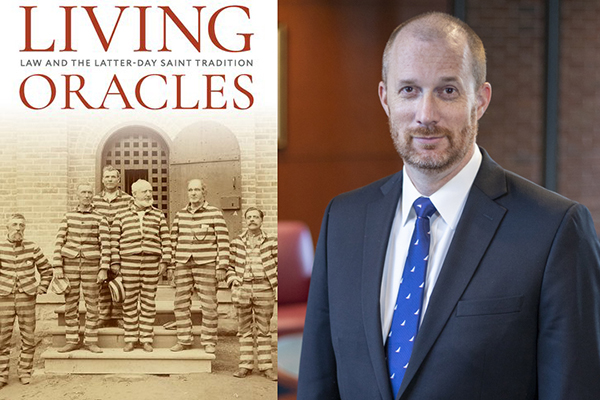
As the first comprehensive history of the Latter-day Saint church court system, the book examines the conflicts between Latter-day Saints and the broader legal system, their efforts to construct alternative legal institutions, and the ways this emerging religious tradition developed a distinctive approach to law. Along the way, it recounts Mormonism’s role in shaping the law of church and state in the United States, the legal controversies surrounding polygamy, and the rise and eventual decline of the Mormon court system.
Below, we ask Professor Oman a series of questions about his book—specifically how it traces key jurisprudential concepts in Mormon thought (including divine and natural law, freedom and equality, and legal obligation) and how it analyzes Latter-day Saint legal approaches in concrete areas such as polygamy, divorce, same-sex marriage, property, contract, religious freedom, and constitutional law.
Q. Professor Oman, what led you to write about law and the Church of Jesus Christ of Latter-day Saints?
A. My ancestors joined the Church of Jesus Christ of Latter-day Saints in the 19th century, so it was my personal background that first sparked my interest. However, as I began to explore Latter-day Saint legal experience, I realized that it is one of the great law & religion stories in American history. It included conflicts over religious freedom, debates over the relationship between church and state, ecclesiastical court systems, and a deep reservoir of ideas and discussions of legal concepts. It is just a really interesting area to me as a legal scholar.
Q. What similarities as well as differences have you identified between legal practices within the church as well as those in Utah or the United States, broadly? How have these bodies informed or influenced each other along the way?
A. The greatest divergence between the Latter-day Saints and the American legal system came in the mid-19th century. After a decade and a half of anti-Mormon violence in the United States, by 1847 the Latter-day Saints wanted to create their own polity independent of the American Republic. They tried to travel beyond the borders of the United States to the Great Basin, but after the Mexican-American War they found themselves once again under nominal American jurisdiction. However, distance created substantial independence. In this context, they created their own economic system based on communitarian efforts, an ecclesiastical court system that handled internal dispute resolution within the community, and—most famously—a polygamous marriage system. In the decades after the Civil War all of these unique arrangements were targeted and systematically dismantled by the federal government. Since the early 20th century, the American Latter-day Saints have largely behaved like other American religious denominations rather than the citizens of a quasi-independent religious commonwealth.
Q. The book is divided into two parts. The first half looking at theological ideas while the second looks more concretely at legal ideas. Why is it important to consider both elements in your review?
A. Religion consists of both beliefs and ideas and practices and actions. My goal was to provide an over-view of Latter-day Saint engagement with the law and the influence of law on Latter-day Saint thought and practice. Hence, in the first part of the book I explore how Mormon theology informs basic jurisprudential questions—like the authority of law or freedom and equality—within Latter-day Saint discourse. In the second part of the book, I provide a more historical account of how Mormonism has dealt with legal topics that have engaged a lot of Latter-day Saint attention, like property, contract, marriage, and ideas of religious freedom.
Q. Historically speaking, how has the church changed its processes and policies over time? Specifically, how does the church today approach disciplinary action for members?
A. All religious traditions change over the time. When the Church of Jesus Christ of Latter-day Saints was founded in the 1830s, church discipline was an important part of the movement, which was common among religious groups at the time. Eventually this focus on church discipline led to the creation of an ecclesiastical judiciary primarily focused on resolving civil disputes among Latter-day Saints. Thus, 19th-century Mormons were not supposed to sue one another before secular courts but rather were to take their lawsuits to the church judiciary. This practice fell into disuse in the opening decades of the 20th century. Thereafter, the church courts' rather elaborate institutional machinery was repurposed as a pastoral tool. However, over the course of the mid-20th century the limits of adjudication as a tool of pastoral care became apparent. Since the 1980s, discipline with the LDS church has become much more informal and less extensive.
Q. While the LDS church has origins within the United States, membership abounds internationally as well. How does the church interact in other countries and fit in with other legal systems around the world?
A. Today the majority of Latter-day Saints are citizens of countries outside of the United States, and the fastest Mormon growth is in sub-Saharan Africa and Latin America. The Church of Jesus Christ of Latter-day Saints thus operates in hundreds of jurisdictions around the world. In many of these countries, the church has faced legal harassment, persecution, and in a few places outright bans. The source of legal hostility toward Mormonism varies greatly from country to country where the church has faced challenges. Over time this dynamic has led to the decline of American-centric discourse within the church and an emphasis on more universal themes like basic civic loyalty and religious liberty as a basic human right. Because the church does not want to place its members in the position of being objects of legal persecution, it has also decided on the minimum legal requirements for living a faithful Latter-day Saint life. Unlike other religious denominations, the church actively eschews proselytizing in countries where doing so will subject Latter-day Saints to official persecution or where local law prohibits the basic elements of Mormon devotional life.
♦♦♦
Professor Oman joined the William & Mary Law faculty in 2006. His work focuses on contracts, the philosophy of private law, and law and religion, with a special emphasis on Mormonism. Prior to becoming a professor, he was a litigation associate in the Washington, D.C., office of Sidley Austin LLP and clerked for Judge Morris Shepard Arnold on the U.S. Court of Appeals for the Eighth Circuit.
To order a copy of his latest book, please visit Oxford University Press.