

Samuel Bagenstos Delivers William & Mary Law School’s Annual George Wythe Lecture
Professor Samuel Bagenstos, a renowned expert in health law and employment law, presented William & Mary Law School’s annual George Wythe Lecture on Tuesday, April 7.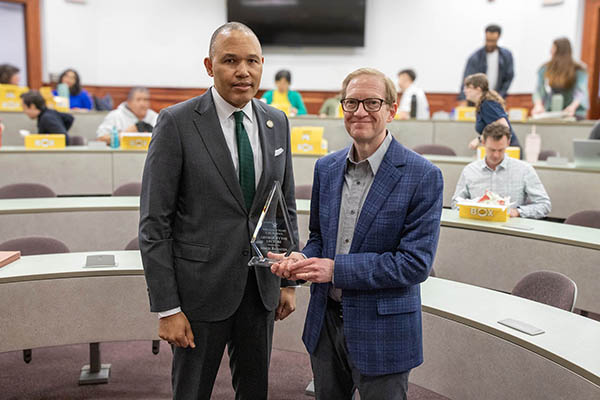
Bagenstos is the Frank G. Millard Professor of Law at the University of Michigan. He is an active appellate and U.S. Supreme Court litigator in civil rights and federalism cases and from 2009 to 2011 served as the Principal Deputy Assistant Attorney General for Civil Rights in the U.S. Department of Justice. He currently serves as Chair of the Michigan Employment Relations Commission.
In his lecture, “Reconstructing the Public Health State,” Bagenstos discussed the state of the country’s public health institutions in the wake of the COVID-19 pandemic. Through a combination of factors, including an increase in politicization around public health policy and a decrease in institutional trust, the public health system has weakened, leading to crises like the current measles epidemic.
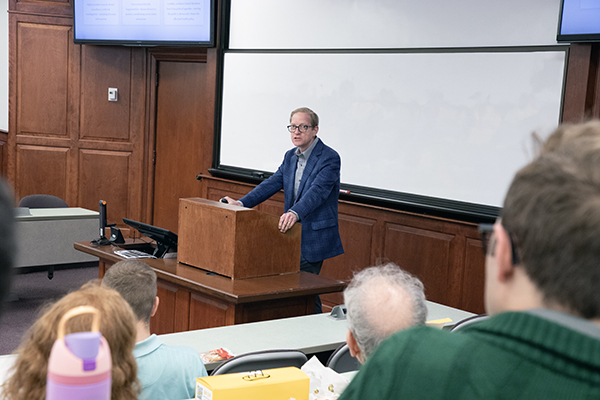 “Public health is inherently political,” Bagenstos argued, because “It involves tradeoffs among various goals, including liberty, economic growth, safety, human flourishing.” Where and when those tradeoffs occur must be determined by the public through the political process, which is where the law comes in. Numerous core elements of the public health system have been created through federal legislation, including the National Institutes of Health (NIH), the Centers for Disease Control and Prevention (CDC), the Food and Drug Administration (FDA), and other agencies and programs that exist to benefit the public good.
The system was designed to give public health officials and experts what Bagenstos called “accountable independence”: enough latitude to make policy decisions free from political interference while still being subject to presidential and congressional oversight. It is not free from flaws, but it was flexible enough to admit corrections when needed, and generally a good model of how a national public health system should function in a democratic society. According to Bagenstos, however, “that whole edifice is crashing down.”
Under the Trump Administration, Bagenstos said, research funding is being cut, sources of public information are being removed, policy decisions are being made based on political ideology rather than scientific evidence, and mass layoffs and impoundment of funds are making it difficult for agencies to function effectively. Because the public health system was established by federal law, it should have been protected from most of these actions, but according to Bagenstos a series of decisions made by the U.S. Supreme Court—including Kennedy v. Braidwood Management Inc.—have made it possible for the health and human services secretary and the president to have more control over the public health system. The impact of these changes is a system that is less effective and less prepared to safeguard public health.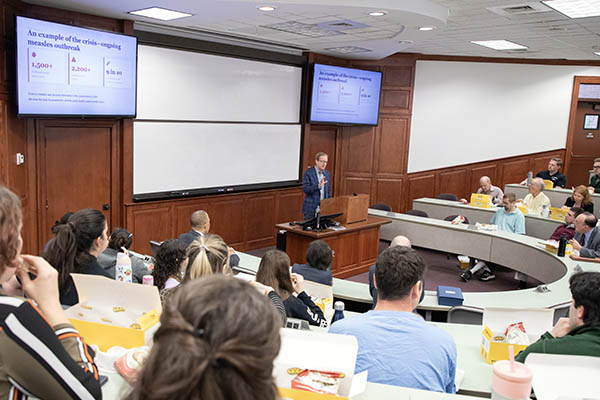
Bagenstos suggested four ways to reform the public health state to prevent future administrations from having an outsized influence: first, enhancing agency independence, which could involve tenure protection for public health officials, enhanced scientific integrity policies, or requiring disciplinary review; second, accountability reform, including Congress and/or the public having more oversight of and involvement in policy decisions; third, more transparency from public health officials about how and why decisions are made; and fourth, moving some public health activities to the state level so that the federal government does not become a single point of failure.
“Now, all of this will require significant changes to administrative, statutory and constitutional law as well as professional practices,” Bagenstos said. “But I would argue that it's essential for public health to return to its function of ensuring that everyone can live longer and better lives.”
Bagenstos’s lecture will be published in the William & Mary Law Review.
Professor Bagenstos is a graduate of the University of North Carolina and the Harvard Law School. Early in his career, he was a law clerk for Justice Ruth Bader Ginsburg on the U.S. Supreme Court and for Judge Stephen Reinhardt on the Ninth Circuit.
The George Wythe Lecture Series began at the Law School in 1976. Wythe (1726-1806) was a distinguished lawyer, statesman, and judge, and a mentor to Thomas Jefferson. In 1779, at Jefferson’s urging, he was appointed as William & Mary’s—and the nation’s—first professor of law.