

Timothy Zick Named Chancellor Professor of Law; Publishes New Book on Executive Power and the First Amendment
Professor Timothy Zick has been named a Chancellor Professor of Law at William & Mary. The professorship, which is awarded to a single faculty member across the university, is one of the University’s highest faculty honors. The 10-year appointment recognizes faculty members who have earned a distinguished record of scholarship, teaching and service, and who have made a lasting impact on the university community. From 2024 onward, only six individuals will hold the title at any given time.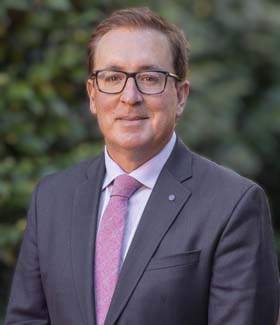
A member of the William & Mary faculty since 2008, Zick is an award-winning teacher and scholar. In 2022, he received the McGlothlin Award for Exceptional Teaching. He has also received three Plumeri Awards for Faculty Excellence and previously held several named professorships, including the Mills E. Godwin, Jr., Professor and the Cabell Research Professor.
Zick is the Robert & Elizabeth Scott Research Professor and John Marshall Professor of Government and Citizenship at William & Mary Law School, where he teaches and writes about constitutional law and the First Amendment. Over the course of his career, he has authored seven books on the First Amendment and more than three dozen scholarly articles and book chapters, earning national and international recognition for his rigorous, accessible analysis of expressive freedoms.
The Chancellor professorship comes on the heels of publication of Zick’s Trump 2.0: Executive Power and the First Amendment (Carolina Academic Press, 2026), a timely and comprehensive examination of how executive actions in President Trump’s second term have affected freedoms of speech, press and assembly.
“Professor Zick’s appointment to so eminent a professorship, coupled with the publication of his latest book, marks a remarkable moment in a career defined by sustained excellence,” said A. Benjamin Spencer, Dean and Trustee Professor of William & Mary Law School. “As both teacher and scholar, he demonstrates the academic rigor and real-world application we are proud to foster at our law school.”
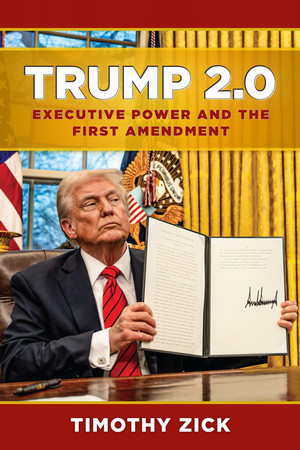 In Trump 2.0, Zick catalogs and analyzes the flood of executive orders, agency actions, court decisions and legal challenges that have emerged during President Trump’s second term. Drawing on executive orders, pleadings, lower court rulings, and internal agency guidance, the book examines how government power has intersected—often in troubling ways—with core First Amendment protections.
“If you had told me in January that I’d have enough material for a book after only about 10 months of Trump’s second term, well I’d have believed you: I published my first Trump/First Amendment book halfway through Trump’s first term,” Zick said.
In April 2025, Zick launched an accompanying online resource, “Trump 2.0: Executive Power and the First Amendment,” through First Amendment Watch at NYU, expanding access to real-time analysis and teaching materials.+
And last July, he began a new Substack, “Thoughts on the First.” The Substack serves as go-to source for students, lawyers, journalists and the general public for understanding how the First Amendment is evolving in real time, and helped the fast progress of his latest book.
A distinctive element of Trump 2.0 is its focus on institutional responses to executive action. Zick examines how law firms, universities, corporations, scientists, libraries and other organizations reacted in real time to government directives that raised constitutional concerns. Each chapter includes doctrinal summaries and problem exercises designed to facilitate classroom discussion, making the book a flexible resource for First Amendment and constitutional law courses, as well as seminars focused on executive power.
The book also offers practical value for clinical and experiential courses, providing materials that demonstrate how lawyers can counsel clients targeted or regulated by federal agencies. While firmly grounded in the legal conflicts of Trump’s second term, the book is intended for anyone who studies, values or actively exercises First Amendment rights.
Zick’s central conclusion is sobering. The ongoing stress test, he writes, reveals that the First Amendment provides necessary, but not always sufficient, protection against the excesses of executive power. He places the current era among the most consequential for expressive freedoms since the McCarthy era of the 1950s, noting that the pace and volume of executive actions pose unique challenges for courts, institutions and the public.
The book has drawn strong praise from prominent scholars and advocates. Nadine Strossen, Senior Fellow, Foundation for Individual Rights and Expression, called the book “an essential resource for understanding how executive power can threaten cherished First Amendment rights and what can be done to preserve them.”
Robert Corn-Revere, chief counsel for the Foundation for Individual Rights and Expression, said that Zick “makes one thing abundantly clear: the rule of law and our hard-won protections for freedom of expression are now more essential than ever.”
Genevieve Lakier of the University of Chicago Law School said, “There is no better way to help students understand what is legally audacious and doctrinally tricky about the Trump administration's assault on the First Amendment than Tim Zick's careful, thoughtful, and critical book.”
Before joining William & Mary, Zick taught at St. John’s University School of Law, where he began his academic career and received the Professor of the Year award. He earned his undergraduate and law degrees summa cum laude from Indiana University and Georgetown University Law Center, respectively, graduating first in his law school class. He has served as a federal appellate law clerk, a trial attorney in the U.S. Department of Justice, and an associate at prominent law firms.
Frequently quoted in local, national, and international media, Zick has testified before Congress and authored numerous op-eds addressing contemporary First Amendment controversies. With his appointment as Chancellor Professor and the release of his latest book, William & Mary recognizes both his past contributions and his continued influence on one of the most pressing constitutional debates of the moment.
To learn more about Trump 2.0, please visit Carolina Academic Press.