

William & Mary Symposium Explores Fight Over Mid-Decade Redistricting Ahead of 2026 Elections
Legal scholars, litigators and reform advocates gathered on April 2 at William & Mary Law School for “Lines of Power: The Case For and Against Mid-Decade Redistricting,” a wide-ranging discussion on the current mid-decade redistricting trend and its implications for the 2026 elections and beyond.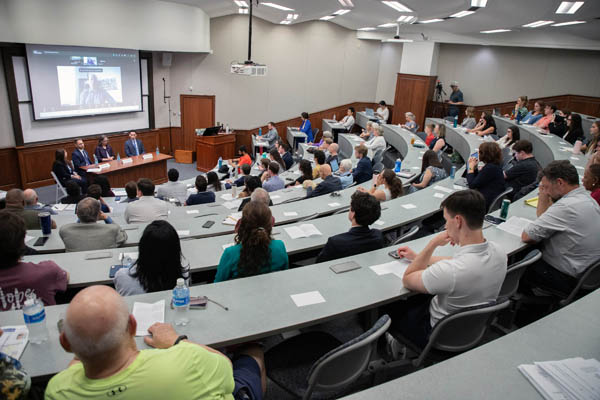
Hosted by the William & Mary Election Law Society, the student-run branch of the Election Law Program, the symposium examined recent efforts by legislatures to redraw congressional and legislative maps outside the traditional 10-year census cycle, as well as the legal challenges and political consequences surrounding those moves.
The event opened with a panel focused on national re-redistricting efforts, featuring speakers from across the legal and political spectrum. Panelists included Mark Gaber, Senior Director for Redistricting, Campaign Legal Center; Katherine McKnight, Partner, Baker Hostetler; Andrew Pardue '20, Deputy General Counsel, National Republican Senatorial Committee; and Joshua Douglas, J. David Rosenberg Professor of Law at the University of Kentucky Law School.
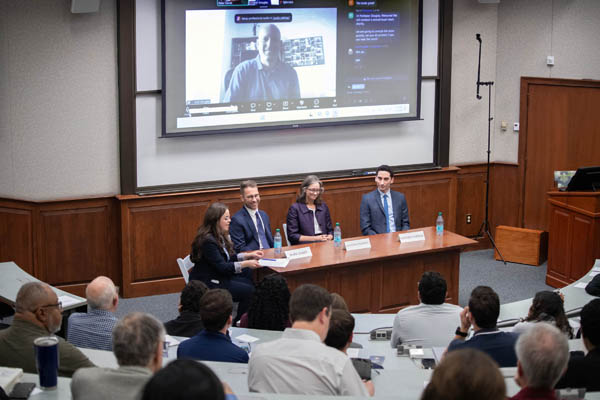 Lauren Sutherland, a first-year law student at William & Mary and co-chair of the Election Law Society’s annual symposium, served as moderator.
Speakers discussed ongoing and potential mid-decade redistricting efforts in several states, the lawsuits challenging those plans, and how courts have grappled with questions of legislative authority, voter representation, and partisan advantage. Panelists also explored possible “off-ramps” to return to traditional decennial redistricting norms, including statutory reforms and constitutional amendments.
Participating via Zoom, Professor Douglas helped set the stage, explaining what redistricting is, how the process typically works, and what legal rules and norms govern it. Going into some depth, he ended by saying that depending on state constitutional constraints, many states are given free rein to draw lines how they want, so long as they ensure equal population between the districts.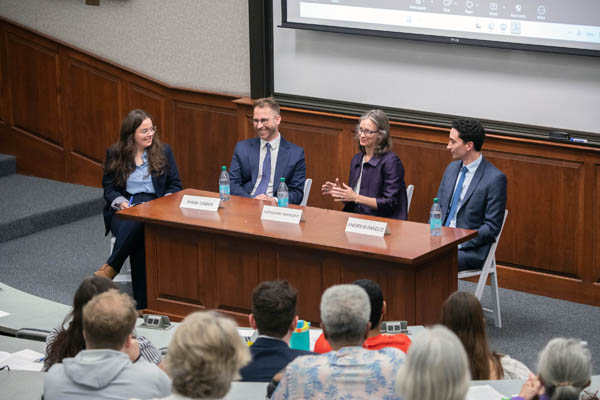
Conversation then pivoted to why redistricting is happening now and the different political and legal incentives driving this movement.
The event also included questions from the audience, the first of which asked for comments on the impact of the Supreme Court's gutting of the Voting Rights Act on the efforts to redistrict.
Another question involved political gerrymandering’s impact on how reflective and responsive representatives are to their districts’ populations. A final speed round focused on the perception that redistricting feels like an arms race, with panelists offering ideas for the best way out or how to carry on with the current process.
Part two of the symposium shifted focus to Virginia, where attendees heard a live-streamed debate over the state’s proposed redistricting ballot referendum. Brian Cannon ’11, executive director of No Gerrymandering Virginia (and former executive director of OneVirginia2021, the group behind the 2019 Virginia constitutional amendment creating a commission process for legislative line drawing), debated Delegate Marcus Simon, a Democrat representing Fairfax County (House of Delegate, District 13). The two offered arguments for and against the current ballot referendum before Virginia voters on April 21.
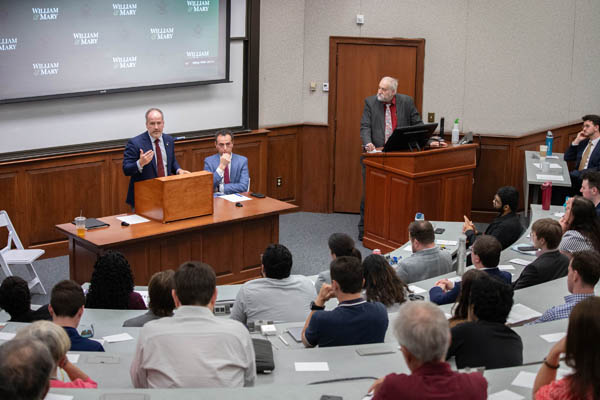 With an introduction from first-year student Madeleine McLean, who polled the audience both before and after the debate, Dwayne Yancey, founding editor of Cardinal News, moderated. Yancey pressed both speakers on issues of transparency, accountability and public trust in the redistricting process.
Both debaters came from a Democratic perspective, but differed on the question of Vote No or Vote Yes, placing on display real conflicts Virginia Democrats have on the measure. For his part, Cannon raised concerns about potential unintended consequences of altering the system voters approved in 2020. Simon argued that Virginia Democrats must act to counterbalance Republican mid-decade redistricting in other states like Texas.
“Everything is at stake in this election,” Simon said. “This is a very big and important election, and what’s at stake is essentially our democracy, and the democracy of the entire country.” Simon added that the goal of drawing districts is “to create a legislature that is responsive to the will of the people.” Congress, Simon argued, will not be responsive to most Americans without Virginians voting Yes.
Cannon countered that Virginia has some of the best, fairest maps in the country. “The Princeton Gerrymandering Project give them an ‘A’ for fairness, and what’s proposed is to take us from the best to the worst,” he said.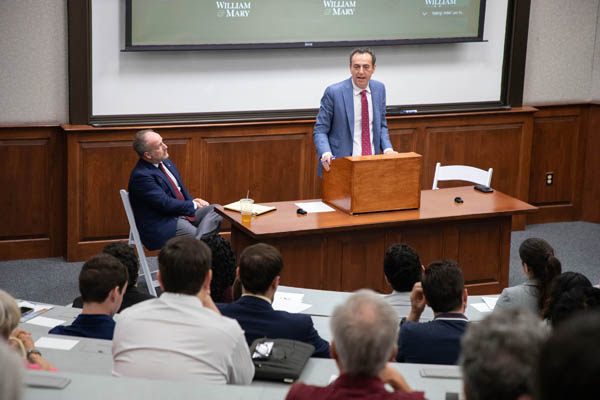
Calling mid-decade gerrymandering “a race to the bottom,” Cannon worried that Virginia would become no better than other states that have taken the bait. “The lie we’re being told is that we have to do this to fight back…but the reality is that we can win 8 to 3 in Virginia fair and square.”
Simon worried that current White House strategy counts on Democrats behaving like Democrats—that they think they’re above it all and play fair. “I’m not above protecting democracy; I’m not above protecting the rule of law; I’m not above making sure that as a country, we have an opportunity to elect a Congress that reflects our values, our votes and the will of our voters,” he said.
The two-hour event concluded with a reception, giving students, faculty and community members an opportunity to continue the conversation informally with panelists and speakers.
As states across the country confront new legal and political battles over district lines, student organizers said the symposium aimed to provide students and the public with a clearer understanding of how redistricting decisions made now could shape electoral outcomes for years to come, including the fast-approaching 2026 elections.
The Election Law Society hosted the symposium, co-sponsoring with other student groups including the Federalist Society, the American Constitution Society, and the Institute of Bill of Rights Law. The livestreamed debate can be viewed here.
“I’m incredibly proud of the Election Law Society’s work to bring this event together, and grateful for the opportunity to moderate such a meaningful discussion so early in my law school career,” said Lauren Sutherland. “I would sincerely like to thank Professor Rebecca Green, James Alcorn, Francesca Ferraro, Peter Favret, and, of course, co-chair Madeleine McLean for their guidance and teamwork planning the symposium.”