

William & Mary’s Supreme Court Preview tackles executive power, jury size and a consequential docket
Advocates, judges and Court watchers gathered at William & Mary Law School to size up the cases that will define the 2026–27 term.
With the Supreme Court’s new term days away, William & Mary Law School hosted its 39th annual Supreme Court Preview on September 25 and 26, taking on some of the most consequential questions before the justices, from the reach of presidential power to the size of criminal juries.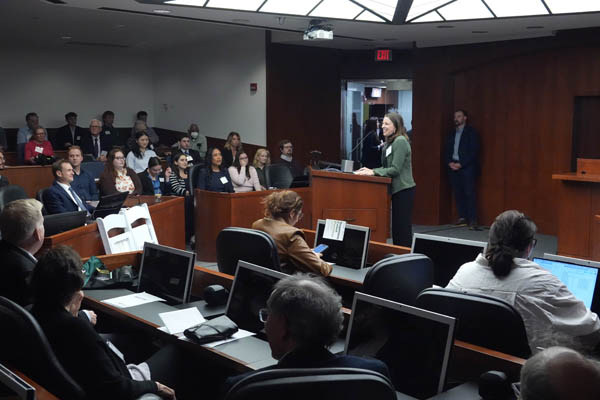
“We have with us this weekend the nation’s top Supreme Court advocates and Supreme Court journalists, along with esteemed scholars who write about the Court and some of the nation’s finest jurists from the U.S. Courts of Appeals,” said Professor Allison Orr Larsen, director of William & Mary’s Institute of Bill of Rights Law (IBRL), as she opened the conference. “Today and tomorrow you will hear these experts discuss, among other things, executive power and the Roberts Court, and what is likely to come from the Court in election law, immigration law, the First and Second Amendment and more.”
Known for looking forward as it looks back, the Preview frames big-picture questions about the Court’s role in American democracy.
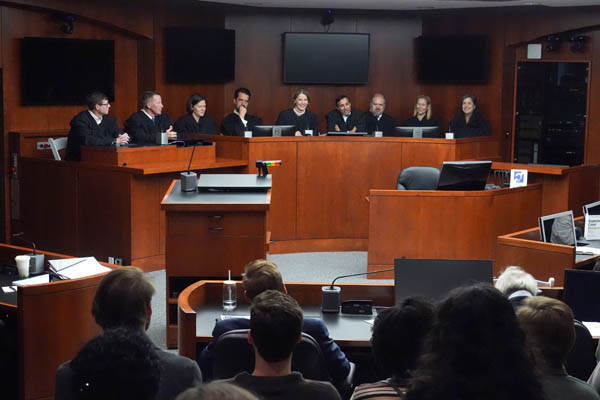 The conference’s centerpiece was a moot court argument in Kian v. Florida, held in the law school’s McGlothlin Courtroom. The pending case asks whether the Sixth and Fourteenth Amendments guarantee a defendant charged with a serious felony a 12-person jury rather than a six-person one. At stake is Williams v. Florida, the 1970 decision holding that the Constitution does not require 12-member juries in state criminal trials.
Jo-Ann Sagar argued for the petitioner and Christopher Michel for the state. Sagar, a partner at Hogan Lovells Cadwalader, is an appellate specialist in state and federal courts with substantial Supreme Court experience. She clerked for Stephen Breyer on the Supreme Court, Brett Kavanaugh on the D.C. Circuit and Ketanji Brown Jackson on the D.C. Federal District Court. In 2025 alone, she was named a rising star by Law360 and one of Bloomberg’s 40 Under 40 leading litigators. Michel, a partner at Kirkland & Ellis, leads the firm’s Supreme Court and appellate practice. He spent more than five years in the Office of the Solicitor General and clerked for Chief Justice John Roberts and Justice Brett Kavanaugh.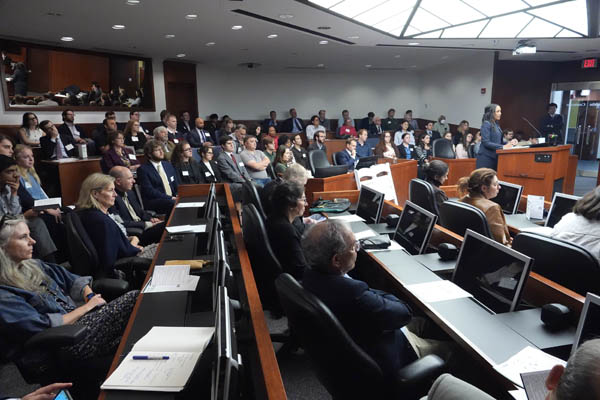
After vigorous debate, and more than a little talk of stare decisis, the moot bench ruled 5-4 for the petitioner, overruling Williams on the grounds that both original historical meaning and modern research show that 12-person juries deliberate better and protect defendants more fairly. As in past years, organizers reminded the audience that the argument was an academic exercise and that the questions and positions of the moot justices and advocates should not be attributed to them personally.
Friday closed with a panel on the Roberts Court’s approach to executive power featuring Jonathan Adler (William & Mary Law School), Pam Karlan (Stanford Law School), Joan Biskupic (CNN), Jonathan Ellis (McGuireWoods) and Irv Gornstein (Georgetown University Law Center). The panelists examined last term’s decision in Trump v. Slaughter, which embraced the unitary executive theory and expanded presidential control over administrative agencies, alongside rulings on birthright citizenship, presidential tariffs and the major questions doctrine that appear to pull in the opposite direction. They also considered what the Court’s approach could mean for the rest of the Trump presidency and beyond. In related note, the IBRL will welcome former Federal Trade Commissioner Rebecca Slaughter (the respondent in that case) to William & Mary Law School on November 10 as part of the annual Koch Administrative Law Forum, a public lecture series honoring the late William & Mary Law Professor Charles H. Koch. Learn more.
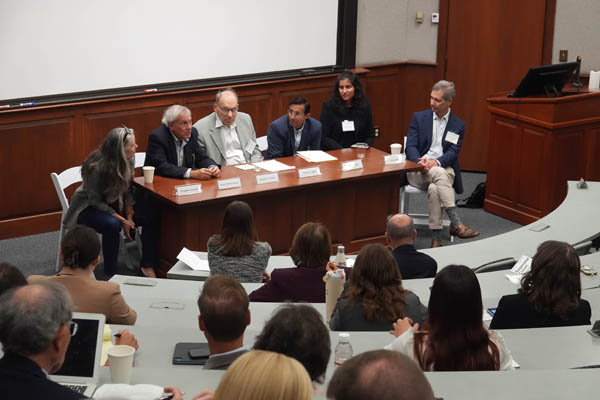 Saturday opened with the Court’s immigration docket, including Wassily v. Blanche, Genalo v. Black and Montoya Palacios v. Liggins, cases raising questions about enforcement, asylum and detention.
A panel of sitting federal appellate judges then took up a deliberately provocative question: Do lawyers actually make a difference? Responding to growing public skepticism that judges decide cases before argument, the judges described how they reach decisions, where advocates have the most room to influence outcomes, and how practice in the courts of appeals differs from that before the Supreme Court.
With midterm elections approaching, a late-morning panel reviewed the Court’s recent election law decisions and previewed Mi Familia Vota v. Fontes, a closely watched case on federal voting rights protections and state election administration. Panelists also discussed the Court’s handling of election-related emergency applications and the disputes likely to reach it during the midterm cycle.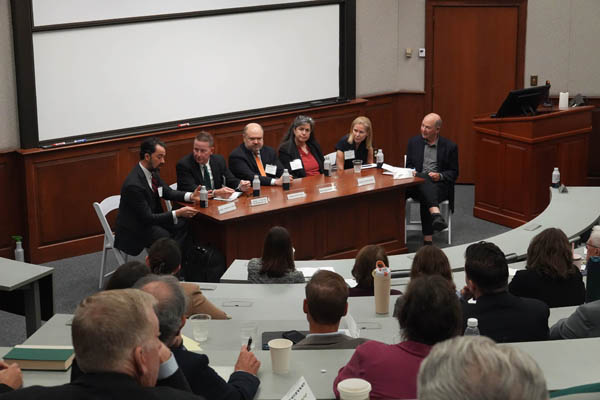
After lunch, attendees chose among three deep dives on employment law, civil rights litigation and criminal law.
The afternoon’s federal-state conflicts panel centered on Suncor Energy v. Board of County Commissioners of Boulder County, which asks whether federal environmental law preempts state common-law climate change claims. Panelists also discussed litigation over state regulation of mifepristone, a pending cert petition on the preemptive effect of the National Bank Act, and the evolving doctrine of state standing.
Panelists noted that in many of these lawsuits, states themselves are divided into those who favor preemption and those who don’t. The battle is drawn upon red and blue state lines. This is different from the past—when states would usually line up together in legal challenges of this type.
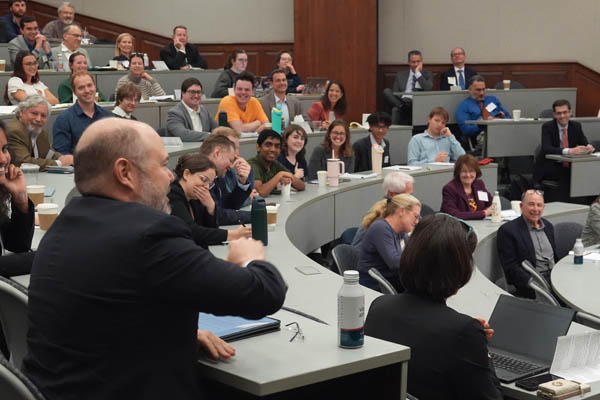 The conference concluded with a panel on the First and Second Amendments. Discussion covered Viramontes v. Cook County, which asks whether the Second Amendment protects the right to own AR-15s; First Choice Women’s Resource Center v. Platkin, involving freedom of association and donor privacy; and St. Mary Catholic Parish v. Roy, which tests the continuing validity and scope of Employment Division v. Smith for free exercise challenges to generally applicable laws.
The Preview is designed to be accessible to a general audience while giving William & Mary Law students rare opportunities to network with panelists at meals, receptions and between sessions.
“The best part and the lifeblood of this law school are our students,” Larsen said, welcoming them Friday. She urged them to “soak it in; ask questions; maybe journal a little bit if you hear something that sparks an idea and bring it to your professor.”
For Molly Morro ’27, IBRL student President, the Supreme Court Preview is a major asset to William & Mary Law School and the broader legal community, bringing together many of the most impressive legal professionals regularly interacting with the country's highest court.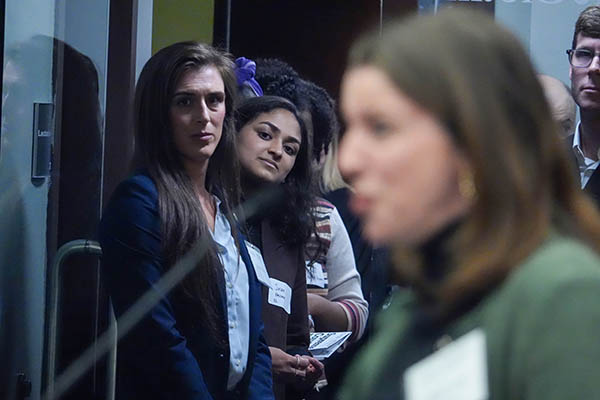
“As the Supreme Court continues to take on some of the most impactful and often divisive legal issues and produce decisions that affect the most intimate corners of American life—i.e., faith, identity, bodily autonomy—I implore students and professionals to continue to take advantage of the opportunity to hear from some of the people most qualified to predict outcomes and consequences of what will come from the Court’s next term,” Moro said. “Being aware and engaged with the Court does not merely hold academic value; I believe it is vital to a vibrant, democratic civil society and, as a law student, to be a true Citizen Lawyer.”
Student Bar Association President Maura Kanter ’27 considers the Preview her favorite event, and when she was a 1L, she was astounded by the speakers and practitioners who had made their way to Williamsburg. “There was something so incredible about seeing people at the highest echelons of the legal field coming together to engage in in collective exercises, healthy debates and broad discussions about our highest court,” Kanter said. “The Preview is a unique opportunity for experts to talk to people with vastly different perspectives and varying degrees of experience in a pressure-free environment. That’s why we have so many repeat players.”
The Preview certainly led to food for thought for participants, particularly when the Election Law panel outlined what challenges they anticipated to come after the midterms. The Federalism panel, too, presented an interesting combination of issues (abortion, climate change, online gambling) that all present federal-state conflicts but without predictable ideological patterns. It featured an amicus brief filed by William & Mary Law School’s Jonathan Adler.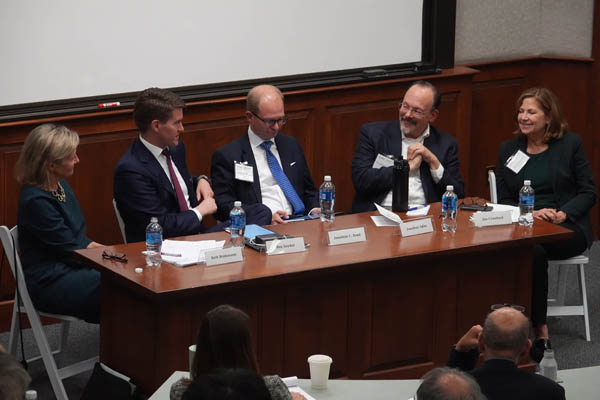
The Preview capped a busy week for the IBRL. On September22, Associate Justice Amy Coney Barrett visited the law school for the institute’s annual Constitution Day celebration, becoming the second justice to speak on campus this year. On her first visit since joining the Court nearly six years ago, Barrett spent the day with students, faculty and staff and signed copies of her book, “Listening to the Law: Reflections on the Court and Constitution” (2025), which offers a look at her daily life as a justice.
On September 25, Sarah Isgur, host of the legal podcast “Advisory Opinions” and editor of SCOTUSblog, discussed her new book, “Last Branch Standing: A Potentially Surprising, Occasionally Witty Journey Inside Today’s Supreme Court” (Crown, 2026), in a wide-ranging conversation about the Court’s inner workings.
“Every year the nation’s foremost Supreme Court experts come down to Williamsburg and share their expertise with us, and it is truly a treasured tradition we have here at William & Mary,” Larsen said. “I learn so much that my brain hurts by the end of the weekend, but it is worth it. I particularly love watching these legal superstars interact with our amazing students, whose smart questions and endless curiosity really make me proud to be part of the Tribe.”
The 40th Supreme Court Preview is scheduled for next fall, and plans for a special anniversary event are under way.
Visit our gallery page for more photos from the 2026 Supreme Court Preview.