

Alumni in faculty roles reflect on pathway to academia
Vania Blaiklock ’18 was in her senior year at Lee University when she fell in love with the law. The political science major was taking a constitutional law class and was brought to tears reading a court opinion by Sandra Day O’Connor. Blaiklock had been intending to take the GRE and apply to graduate programs in education, but she quickly pivoted to LSAT preparation. For the Hampton Roads native and avowed history buff, William & Mary Law School was the dream.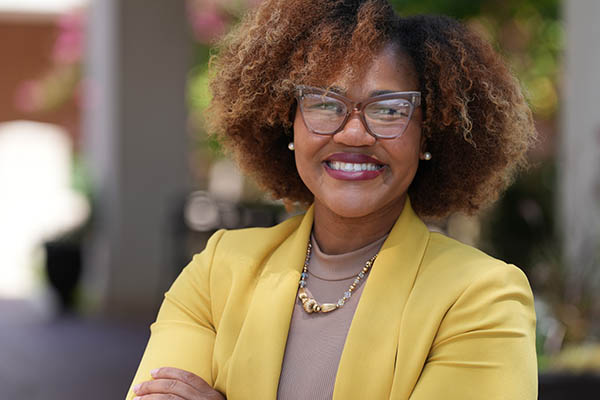
“I came to visit during Spring Break and there were no students here, and I had to take the recorded tour. And there was all the conversation about the citizen lawyer piece, and that was really important to me,” Blaiklock said. “I wanted to be in an environment where the people that would become my lifelong friends were also people who were committed to making the world better and using law to make the world better. And that was very true for my incoming class.”
Blaiklock thrived in law school, but she came in without a clear career path in mind. While many students plan their curriculum around a particular field or role, Blaiklock took any course that sounded interesting or was taught by a professor she admired. She interned at a non-profit organization and a firm, accepting a full-time position with the firm after graduating.
“I just loved law school for the sake of law school. I took classes in areas I had no interest in, like health law and food and drug law. I took state and local tax. Every semester the wind would blow and I’d be like ‘maybe I’ll be a tax attorney!’ But I loved the study of law itself,” Blaiklock said. “And then that’s why I kind of had a crisis when I then became a lawyer…and I hated it.”
Blaiklock loved the firm, and loved the people she worked with, but she quickly realized this was not how she wanted to spend the rest of her life. She confided in one of her former professors, Allison Orr Larsen, about her struggles, and Larsen told her that from the moment she had met Blaiklock, Larsen knew she belonged in the law classroom. With the support of her mentors and her family, Blaiklock decided to take the leap.
The Path to Professorship
The road to law academia is not often easy, nor is it straightforward. However, it can be a highly fulfilling career path for those like Blaiklock who prefer the study of the law to the practice of it, for those who excel at scholarly research or for those who want to make a broader impact on the justice system.
Blaiklock’s path took her back to school. She returned to William & Mary to pursue a Master of Arts and a Ph.D. in American Studies. This approach gave her publishing and teaching experience, which are both necessary for an academy candidate to be competitive. She even had the opportunity to teach a seminar at William & Mary Law School. Earning graduate degrees took an additional six years, but Blaiklock will be joining Washington & Lee School of Law in the fall as an Assistant Professor of Law.
Another approach to obtaining a full-time faculty appointment is by starting as a visiting associate professor of law. These short-term appointments allow scholars new to the academic space an opportunity to gain teaching experience and publish original scholarship.
Like Blaiklock, Mary Catherine Amerine ’17 did not graduate law school with the intent to eventually become a professor. Unlike Blaiklock, Amerine came in to law school with a specific area of practice in mind: intellectual property law.
 Amerine, who had majored in English at The Catholic University of America, said, “I realized that as much as I loved writing myself, I didn’t have that dying need to write the next great American novel. That wasn't what I was most passionate about. Instead I wanted to help protect the creators I admired, who I had seen struggling with copyright protection.”
For seven years after law school, Amerine practiced in the fields of copyright, trademark and false advertising. She loved litigation, but she also had an article idea she was eager to dive into. Making time to focus on research while actively practicing proved difficult, so she applied for an Edison Fellowship, a non-resident fellowship at the Center for Intellectual Property and Innovation Policy at Antonin Scalia Law School, George Mason University. The fellowship gave her the structure to work on the article without leaving active practice. She continued to balance the two priorities for a few years until the Frank H. Marks Intellectual Property Fellowship opened up at the George Washington University Law School.
Leaving litigation for academia meant walking away from directly helping creators protect their work, but it also allowed Amerine to explore the areas of the law she is most passionate about and publish work that impacts the practice of intellectual property law more broadly. And the Marks Fellowship was the perfect introduction to an academic career — both of Amerine’s intellectual property professors at William & Mary, Laura Heymann and Sarah Rajec, had been Marks Fellows. Following in the footsteps of her mentors felt meant to be, and Amerine accepted the two-year fellowship. She will next be moving to a tenure-track position at the Loyola Law School.
“Have You Considered Becoming a Professor?”
Noah Chauvin ’19 was “dead set” on becoming a pediatrician, wanting a career where he could help people, but in college discovered that his talents tended more toward researching and writing than organic chemistry. The law seemed the perfect melding of his skills and passion. 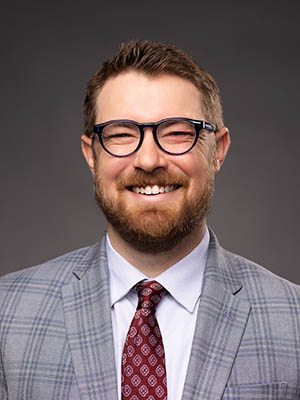
Chauvin explored several different career options in law school, interning with the U.S. District Attorney’s Office in Newport News, Virginia and with a large firm. In his third year, he completed an independent legal study on the application of the First Amendment on university campuses. At one point during that semester he happened to run into Professor Adam Gershowitz, who asked how the work was going.
“I was telling him how much I enjoyed getting to research and write this paper and how I wished there was a job in legal practice where I got to do that kind of thing. And he said, ‘Well I don’t know that that job exists, but have you considered becoming a professor?’” Chauvin recalled.
The idea seemed too aspirational at first — all of Chauvin’s professors were brilliant scholars, and while he did well in law school, he didn’t know if he could picture himself among their ranks. But after discussing the possibility with several other faculty members, Chauvin realized that working in academia was not only achievable, but his dream career.
Unlike Blaiklock and Amerine, Chauvin left law school knowing that teaching was his ultimate goal. He applied for faculty postings while also gaining experience in judicial clerkships and at the Department of Homeland Security.
“I knew I wanted to be a professor, and so the professional decisions I made were made with an eye toward making that happen,” Chauvin said.
Chauvin achieved his goal in 2024, joining the faculty of Widener University Commonwealth Law School as an assistant professor of law. He is now an associate professor of law at the University of Oklahoma College of Law.
Despite their different paths to academia, Blaiklock, Amerine and Chauvin share several commonalities: they love the study of the law, and they love teaching the next generation of lawyers.
“I love my students,” Amerine said. “They bring this fresh perspective, this interest, this passion.”
“They bring me hope,” Blaiklock said.
When asked what advice they would give to law students interested in academia, they also had similar thoughts: find an area of the law that you love, and dig in.
“Make sure that you’re doing research, writing articles. Having publications under your belt is absolutely essential,” Chauvin said. “Find areas of the law that interest you, figure out the interesting problems in them, and write.”
All three professors also discussed the importance of finding mentors who know the process and can offer advice. William & Mary Law School faculty provided essential guidance as each considered pursuing a job in academia.
“Everything I do in the classroom, I am aping at least one of my professors from William & Mary,” Chauvin said. “I was blessed at William & Mary to have some really incredible teachers who put a lot of time and effort into the craft of teaching. It’s still kind of aspirational for me to get there, but hopefully I will one day.”
Law professors have a dual responsibility to train future lawyers while using their expertise and knowledge to shape the legal systems of the nation. Although the path to professorship can be complicated, for those who feel called to the role, there are few positions more rewarding.
“I think a lot of us come into law school thinking there are only two paths, law firms or public service, and that’s just not true,” Blaiklock said. “I have friends who aren’t practicing anymore who are doing things with a J.D. that you wouldn’t even think of. So it’s okay if you don’t have a straight path. In the micro, some of the decisions I made for my career didn’t make sense, but here I am a few years later with my dream job. It doesn’t have to be linear, because once you find the thing that is for you, you’ll be happier.”