

Allison Orr Larsen Examines the Information Dynamics Behind Constitutional Law and Legal Institutions
Professor Allison Orr Larsen’s scholarship has shaped how legal scholars and courts think about amicus briefs, judicial fact-finding, the use of precedent, and the evolution of doctrine. Her testimony before the Senate Judiciary Committee and the Presidential Commission on Supreme Court Reform underscores her influence beyond academia.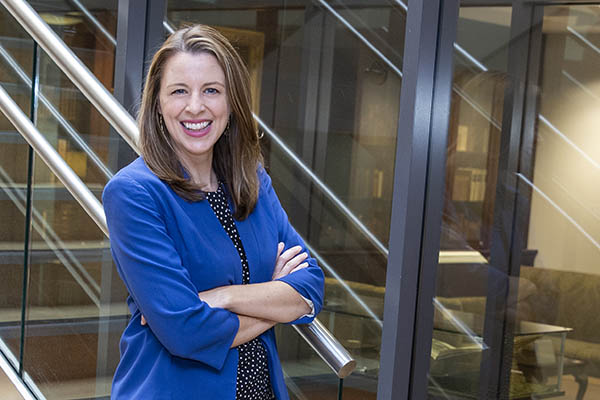
Larsen is the Taylor Reveley Research Professor, Alfred Wilson & Mary I.W. Lee Professor of Law and Director of the Institute for Bill of Rights Law at William & Mary Law School. She teaches courses in constitutional law, administrative law, and statutory interpretation.
A Charlottesville, Va., native and magna cum laude graduate of William & Mary, Larsen finished first in her class at the University of Virginia School of Law. She then served as a law clerk for Judge J. Harvie Wilkinson III of the U.S. Court of Appeals for the Fourth Circuit and for Justice David Souter of the U.S. Supreme Court.
After clerking, Larsen practiced in the appellate litigation division of O’Melveny & Myers in Washington, D.C., and then started her teaching career at William & Mary in 2010. Since that time, Professor Larsen has visited at both Oxford University and Harvard Law School.
Larsen’s scholarship explores how information dynamics shape judicial decision-making. Her most recent article, “Is History Precedent?” (forthcoming Stanford Law Review) discusses the growing temptation for judges to cite each other on historical claims. Another recent work, “Becoming a Doctrine” (Florida Law Review, 2024), examines how modern tools like social media and amicus briefs accelerate the transformation of legal ideas into doctrine.
She is perhaps most well-known for her work on Supreme Court amicus briefs (“The Trouble with Amicus Facts” and “The Amicus Machine”), which collectively explore how amicus briefs get to the Supreme Court, and the concerns that come from relying on them as factual experts.
Larsen and her William & Mary Law colleague Neal Devins have also written a series of articles about partisan dynamics and important counterforces at work on the U.S. Courts of Appeals. In “Weaponizing En Banc” (NYU Law Review, 2021) they consider new partisan patterns in en banc practices, and in “Circuit Personalities” (Virginia Law Review, 2022) they discuss how local norms and traditions work to combat partisan impulses.
Professor Larsen’s additional forthcoming books and articles include: “How the Courts Can Save Themselves” (Oxford University Press, with Neal Devins); “History’s Identity Crisis” (SMU Law Review, 2025), and “What makes a Con Law doctrine and why does it matter” (WM Bill of Rights Journal, 2026).
Larsen’s work has been cited by multiple U.S. Courts of Appeals and featured in top law reviews including NYU, Stanford, Virginia, and Cornell.
Larsen is also a frequent voice in national legal discourse. In a recent SCOTUSblog tribute, “The Heartbeat of the Law is Human Connection,” she reflected on her clerkship with Justice David Souter, emphasizing the human dimension of legal decision-making. She was also a featured guest on Strict Scrutiny to discuss Justice Souter’s legacy, and Holding Court, where she explored how judicial temperament influences appellate outcomes. No stranger to podcasts, in June 2024, Larsen appeared on the 99% Invisible podcast, “Fact Checking the Supreme Court” to discuss her work on SCT fact finding.
Larsen’s insights have appeared in The New York Times, Washington Post, CBS News, and Bloomberg, especially on topics like Supreme Court fact-finding and the influence of amicus briefs. She even explained amicus briefs to Stephen Colbert on The Colbert Report in 2014.
A celebrated educator, Larsen has received numerous awards honoring her teaching and scholarship, including: the university’s Alumni Fellowship Award, the 1L Professor of the Year award, two university-wide Plumeri awards, the inaugural McGlothlin Teaching Award, two Walter L. Williams, Jr., Memorial Teaching Awards, and the state-wide outstanding faculty award in the “rising star” category. She is also the national constitutional law lecturer for the Themis Bar Review.