

Regulations Research
Introduction
Legislatures sometimes delegate responsibility for creating law to administrative agencies. With their subject-matter specialists on staff, agencies are sometimes better able to address topics that are complicated or unpredictable. Law created by agencies is known as administrative law, the most important part of which are regulations (sometimes called rules). This handout focuses on researching federal regulations, but the same principles apply to state regulations. Current federal regulations are organized by topic in the Code of Federal Regulations (CFR).
Where to Access the CFR
Annotated
Unannotated
Enabling Legislation
An agency needs authorization from Congress before it can create any regulations. Congress grants this authority through a statute called enabling legislation. Enabling legislation designates what agency has the authority to create rules and sets the boundaries of that authority. If you are reading a U.S. Code section, you have several tools you can use to find the regulations associated with that section. For example, 15 USC § 1453 sets out labeling requirements for consumer goods, but we want to find out if an agency has passed any regulations that specify what the requirements are for fruit juice, and where we can find those regulations in the CFR.
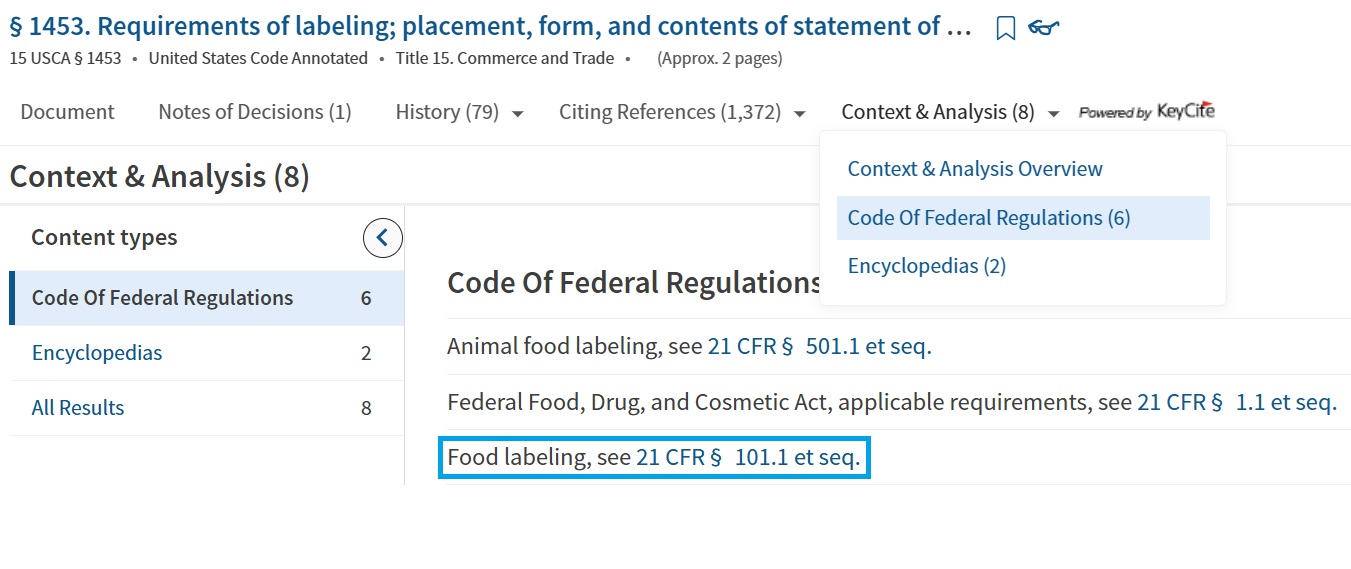
If you are reading a US Code section in Westlaw, select the Context & Analysis tab, then Code of Federal Regulations. This will give you a selective list of regulations an agency has created using the authority of this code section.
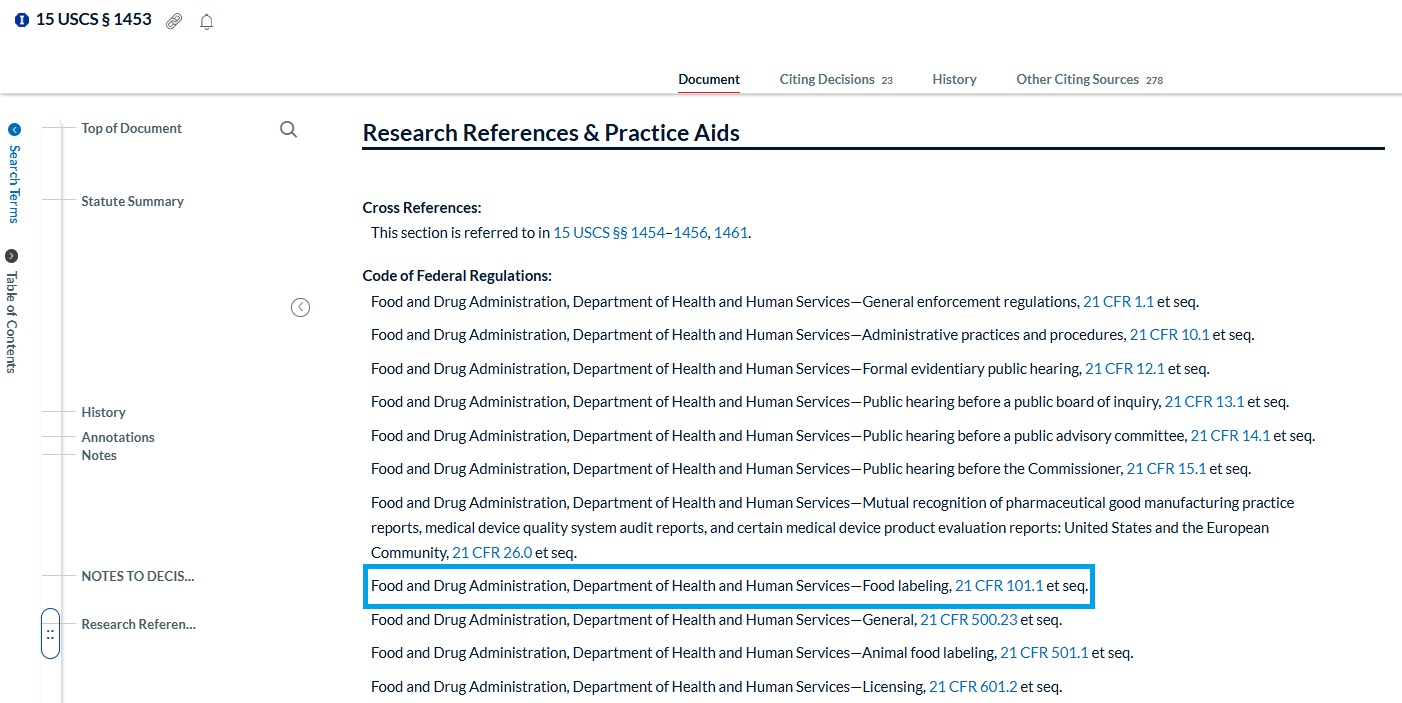
In Lexis, select Research References & Practice Aids to find a selective list of regulations an agency has created using the authority of this code section.
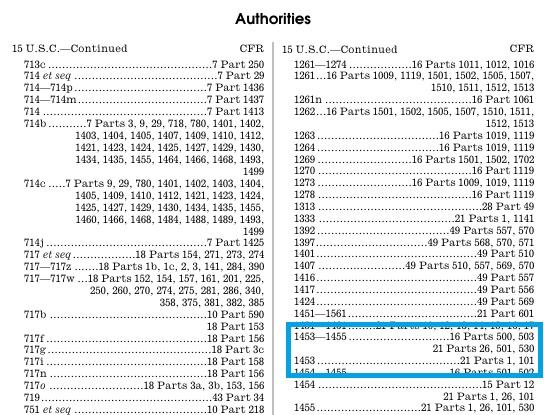
If you are using the federal government's free eCFR or Govinfo.gov websites, refer to the Parallel Table of Authorities and Rules, located within the CFR Index and Finding Aids.
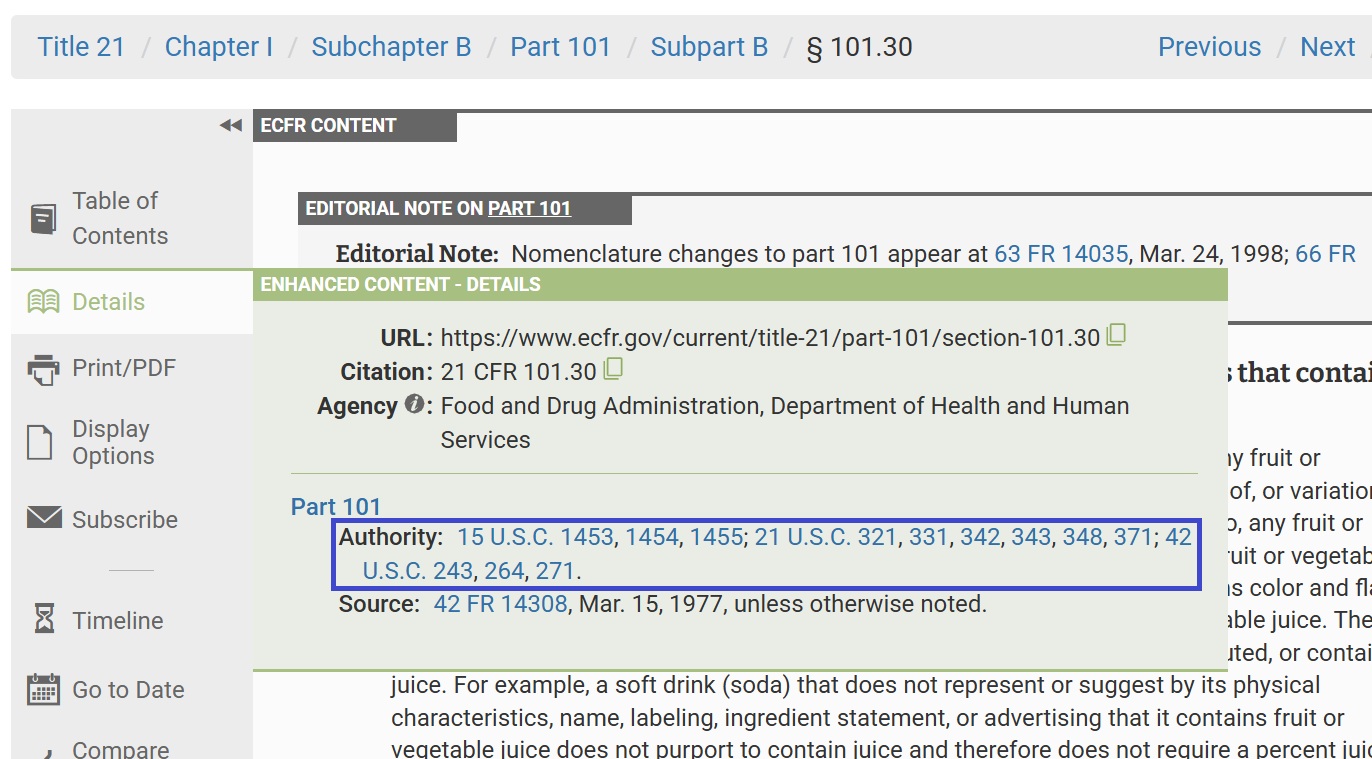
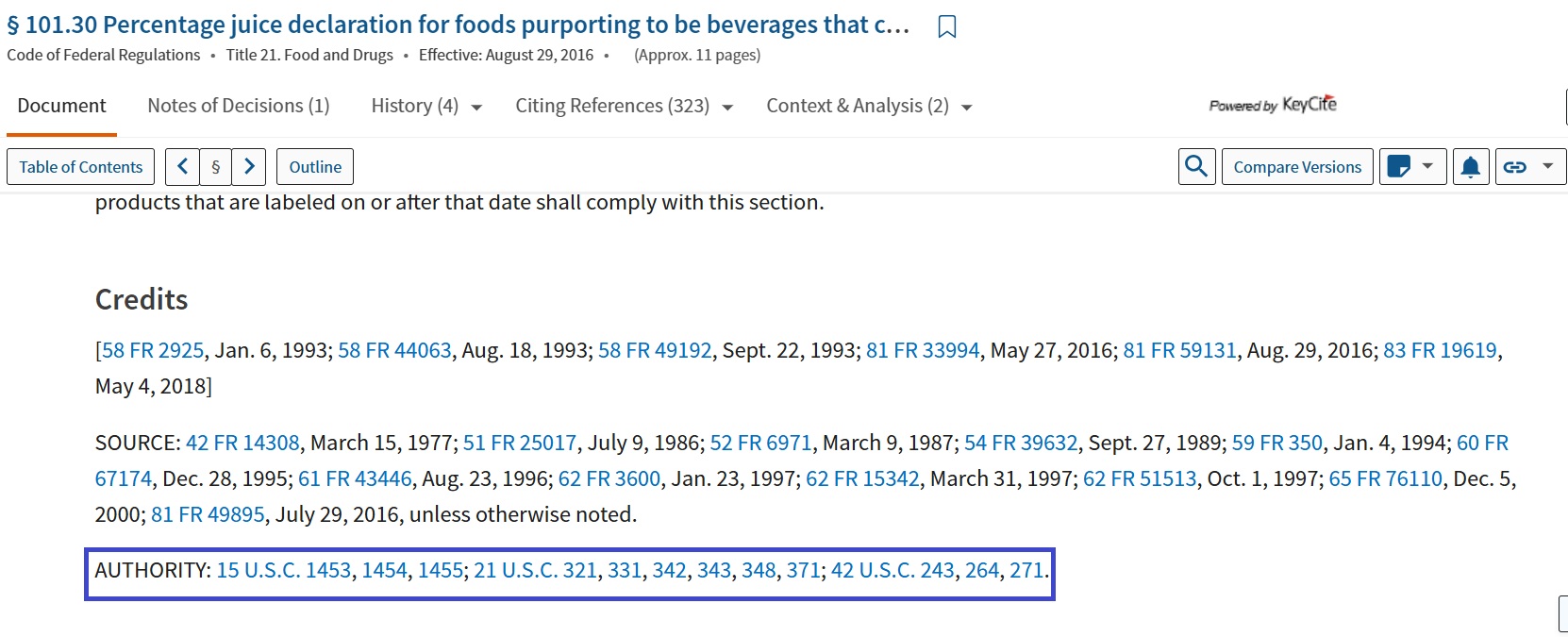
If you are reading a section in the CFR and you want to know where to find the enabling legislation, look for the line that says AUTHORITY or STATUTORY AUTHORITY.
If you are reading a section in eCFR, you will find this information by selecting the "Details" button.
If you are reading a section in Lexis or Westlaw, the Authority information will be after the text of the regulation.
Finding a Regulation in the Code of Federal Regulations
A citation to the CFR looks similar to a citation to the U.S. Code. Here’s a citation to the CFR section on fruit juice beverage labels:
21 CFR § 101.30 (2019)
- 21 is the Title – a subject division of the CFR.
- § 101.30 is the specific section – Section 30 of Part 101. A Part is a subject subdivision of the CFR. Many finding aids may point you to a Part of the CFR instead of a section.
You can enter this citation in eCFR, Lexis or Westlaw to get the text of the regulation.
Final Rules and Proposed Rules in the Federal Register
When an agency creates a new regulation, it must first publish it as a proposed rule in the Federal Register and allow the public to submit comments. After the comment period is over and the agency has made any changes to the regulation as a result of the comments, the agency publishes it in the Federal Register as a final rule, which is binding law. The final rule is then arranged by subject in the CFR. The process is similar to how a bill becomes a statute:
| Stage | How a Federal Regulation Becomes Law | How a Federal Statute Becomes Law |
|---|---|---|
| Proposal | Proposed Rule | Bill |
| Discussion | Comment Period | Floor debates, committees |
| Passed | Final Rule | Session Law |
| Codified | Code of Federal Regulations | United States Code |
When the proposed rule and final rule appear in the Federal Register, they are published together with background information. Reading this background information can help you better understand the purpose and meaning of a regulation, just as legislative history can help you understand statutes. To find a final rule in the Federal Register, go to the history line at the end of a CFR section. This line will identify the final rules that created the CFR section with citations to the Federal Register in chronological order. Here is the history line in the eCFR for 21 CFR § 101.30:
[58 FR 2925, Jan. 6, 1993, as amended at 58 FR 44063, Aug. 18, 1993; 58 FR 49192, Sept. 22, 1993; 81 FR 33994, May 27, 2016; 81 FR 59131, Aug. 29, 2016]
You can enter the Federal Register citation in Westlaw, Lexis, or the free government website federalregister.gov. To find a proposed rule, look in the background information at the beginning of the final rule’s entry in the Federal Register. Usually, the entry begins with a summary of the rule, then may include a statement of costs and benefits, followed by a history of the rule. Somewhere near the beginning of this history, you will find a citation to the proposed rule. Look for mention of a proposed rule or a Notice of Proposed Rulemaking (NPRM). For example, to find the final rule that amended 21 CFR § 101.30 on May 27, 2016, look in that CFR section’s history line and find a citation to 81 FR 33994:
- 81 is the volume of the Federal Register.
- 33994 is the page number within Volume 81.
Enter the citation 81 FR 33994 in the “Search Federal Register Documents” search form on federalregister.gov. You will get a result that looks like this:

Page 33994 is where the text of the regulation itself appears. In this case, you want the background information, which begins on page 33741.

Towards the beginning of the background information, you find a citation to the proposed rule at 79 FR 11879.