

Supplying fishing rod and pond: William & Mary Law Library teaches best practices in AI
“In the nonstop tsunami of global information, librarians provide us with floaties and teach us to swim.” — Linton Weeks
When Washington Post staff writer Linton Weeks wrote that in January 2001, the internet was an ocean of loose information in need of relentless fact-checking and expert curation. A quarter century later, AI has been added to the mix, making the tireless work of librarians even more crucial as they train communities to navigate digital noise, misinformation and deceptive content.
At William & Mary Law School, the librarians at the Wolf Law Library are proving more than up to the challenge.
Helping lead the effort as AI reshapes the legal profession are Leslie A. Street, Herbert V. Kelly, Sr. Professor, Clinical Professor of Legal Research and Director of the Wolf Law Library, and Madeleine “Mads” Ball ’20, who was recently hired as the school’s Emerging Technologies Legal Practice Librarian.
Street says the shift facing law schools today is fundamental. Students arrive on campus already having used AI as an educational tool, but law school must prepare them for something different: AI as a practice tool, deployed by working attorneys with real clients and real consequences. That distinction drives much of the library’s strategy.
“The challenge for us is making sure that students still get the cognitive development they need to have those critical thinking skills, which are imperative to forming legal arguments, that they get the substantive knowledge that they need without using AI as a crutch,” Street said. “In turn, they can use the knowledge and skills they develop to become more effective and skilled practitioners with the addition of AI.”
Ball, who returned to her alma mater after practicing IP litigation, sees the library’s role in similarly practical terms. For her, the job isn’t about the substance of the law itself, but about how lawyers get the work done—and that gap is where her position was created to help.
 One of the library’s central decisions has been when to bring AI into legal education, not just how. Working with Professor Laura Killinger, Director of the Legal Practice Program and Clinical Professor of Legal Writing, Street helped decide that the first year of law school should stay focused on foundational knowledge and skill-building, deliberately keeping AI out of the earliest stages of legal education so it doesn’t interrupt that essential formation.
“We really want the first year to be focused on knowledge creation and essential skill development, because AI shouldn’t come in too soon and cut off that essential knowledge formation,” Street said. “We want students to understand, here’s what it takes to be a lawyer. Here’s what you need to do, and then think about, at what points in time, does AI enhance their legal practice.”
Instead, the Law School is building AI instruction for upper-level students, once they’ve developed the doctrinal grounding and critical-thinking skills to use the technology with real judgment. Ball, in her first year in the role, is helping shape exactly what that upper-level curriculum will look like, a project she calls one of the most exciting parts of her new job.
“The things that I’m really looking forward to this year are, one, assessing and figuring out how we roll that into 1L education, if at all. Is this the right time to teach new students about AI and how to use it, or is that better suited to later in their legal education?”
Ball also sees herself as an AI resource within the law school. She wants students, faculty, and staff to think of her as a sounding board on whether and how AI should be woven into their projects, scholarship, and research. “I really want to be a knowledge bank in a big way,” she said.
Her biggest task right now is helping shape the school’s approach to upper-level AI education. “That’s so exciting, and I think William & Mary is really at the forefront on that,” she said. “It’s exciting to be part of, and I think in a lot of ways, the vanguard of legal education on AI.”
Both librarians emphasize that the specific AI platforms students learn in law school may not follow them into practice, since every firm has its own subscriptions and, increasingly, its own custom-built tools. That reality shapes their teaching philosophy.
“It’s less about teaching students the actual mechanics of using an AI tool, because that’s not necessarily going to translate post-graduation,” Ball said. “It’s about teaching how to use AI competently, responsibly, and in the right manner for the task they’re doing. That’s much more of a judgment call than a technical skill.”
In her advanced legal research class, Street has noticed students already thinking hard about the right moment to bring AI into their process rather than treating it as a shortcut. Her advice: don’t reach for AI to generate an argument or hand you your cases. Use it later in the process, after you’ve done the reading and formed your own thinking, to stress-test your argument and surface counterpoints you might have missed—much the way the Socratic method sharpens thinking in the classroom.
The librarians are candid about the risks. Street points to a wave of sanctions against attorneys—from solo practitioners to lawyers at large firms, and even the Department of Justice—for submitting briefs that cite cases that don’t exist, or real cases with fabricated holdings. She calls it a cautionary reminder of what happens when AI is misused in legal research.
The library’s response is to fold information literacy directly into its teaching. Every librarian at William & Mary Law School holds a J.D. alongside a master’s degree in library or information science. Street says this dual training gives them a distinct lens for helping students evaluate not just information, but the tools that deliver it—a skill that will matter throughout students’ careers as new AI products continue to emerge.
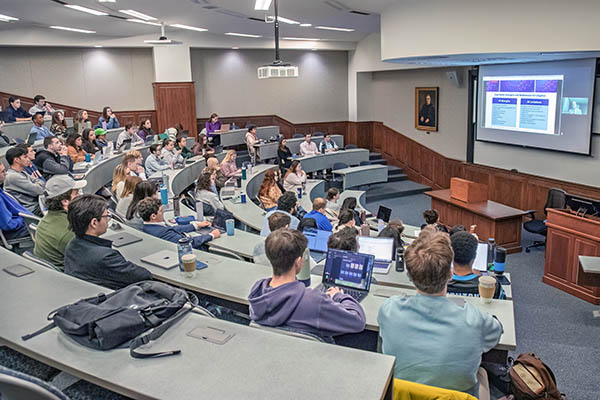 The conversation extends beyond the classroom, too. Street and Ball both say students raise concerns unprompted: worries about AI’s effect on entry-level legal jobs, and broader questions about the technology’s societal costs, from data-center development to changes in local zoning. Ball says she isn’t pessimistic about AI displacing junior associates in the near term, but she sees teaching students to work confidently alongside AI as a direct way of addressing that anxiety.
“Part of our role is to address that by teaching students how to use AI effectively, or at least work with people who use AI, so that they don’t become obsolete, or feel obsolete, once they start practice.”
Ball sums up the library’s philosophy with an analogy: “Not only do we provide the fishing rod, so to speak, and teach people how to fish, but we provide the pond. We have so many incredible resources here. But it’s also the idea that not everything that comes out of AI is going to be perfect. It’s up to you, in your professional judgment, to make sure you’re doing right by your clients.”
Street sees this as a moment of genuine opportunity for the students now moving through the law school. They are the ones, she says, who will eventually sit in positions of power at firms and decide what role AI ultimately plays in the legal profession, a responsibility she calls both daunting and, approached thoughtfully, a chance to shape the technology’s use for the better.
“What excites me is that I think that students today get to determine what the future looks like,” Street said. “They get to decide how they want to use AI, what products they want, how they want to use it in the future, and how to make it better.”
Learn more about AI at William & Mary Law School.