

William & Mary Law School virtual panel with Tess Bridgeman and Matthew Waxman weighs legal questions behind the U.S.-Iran conflict
On November 4, William & Mary Law School’s Center for International Law & Policy, the Center for Comparative Legal Studies and Post-Conflict Peacebuilding and William & Mary's Reves Center for International Studies hosted a virtual panel on the U.S. war with Iran.
Tess Bridgeman of Just Security explained how international law applied to the conflict, and Matthew Waxman of Columbia Law School addressed domestic law. Professors Evan J. Criddle and Christie S. Warren moderated; Robert “Butch” Bracknell convened.
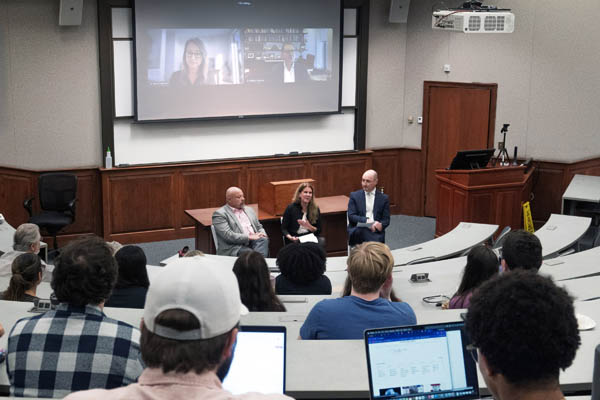
The two experts agreed more than they disagreed. Both faulted the administration’s lack of transparency and disregard for legal limits. But they split on how strong its legal case is and whether law or politics better checks a president at war.
The war began in February, when the United States and Israel struck Iran’s nuclear program and killed Supreme Leader Ali Khamenei. Iran answered by closing the Strait of Hormuz and attacking U.S. bases and regional allies. No lasting settlement has emerged.
Bridgeman called the war a clear breach of Article 2(4) of the UN Charter. The Charter permits the use of force only with Security Council authorization or in self-defense against an actual or imminent armed attack. Iran had no nuclear weapon and posed no imminent threat, she said, and even if it did, the mere capability to conduct a nuclear strike would not justify a military strike. The Charter is a ratified treaty and therefore “supreme law of the land,” Bridgeman argued, so breaching it also violates the president’s constitutional duty to faithfully execute the laws.

Waxman viewed the legality of US and Israeli strikes against Iran as a closer call. The administration’s best argument, he said, is collective self-defense: that the United States joined Israel’s existing armed conflict with Iran. Bridgeman countered that hostilities had markedly decreased after the June 2025 conflict, which made the argument for collective self-defense more tenuous.
Bridgeman also found fault with how the United States and Israel have conducted the war. Targeting political leaders outside the military chain of command violates the principle of distinction, she said. She also drew attention to a strike against an elementary school on the war’s first day that killed at least 175 people, most of them children. Bridgeman argued that the United States’ failure to take feasible precautions likely constituted a war crime, and she raised the possibility that the tragedy might reflect risks associated with to AI-accelerated targeting. To make matters worse, public officials’ threats to grant “no quarter” and destroy Iran as a civilization were themselves unlawful, she added.
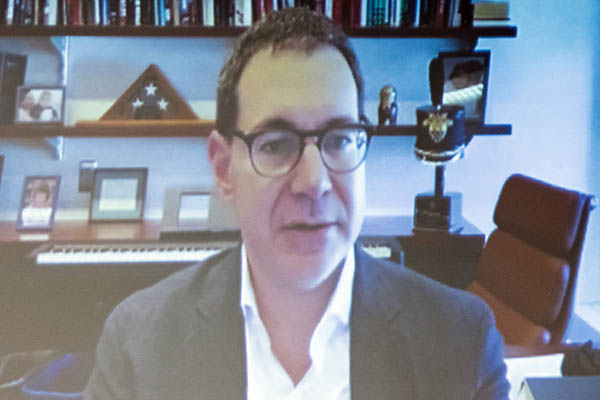
Turning to domestic law, Waxman noted that courts have largely refrained from reviewing the political branches’ decisions on the use of force, so domestic war powers have been shaped mostly by practice. He characterized the president’s authority to strike Iran as a close question because it occupies a position between ground wars, for which modern presidents have sought congressional authorization, and air campaigns, which presidents have launched alone.
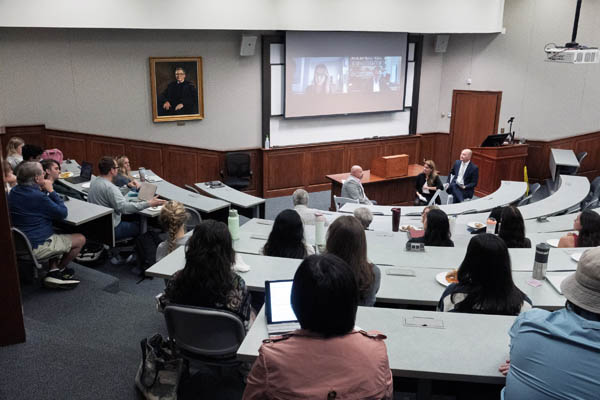
The sharpest divide over domestic war powers related to potential remedies for illegal uses of force. Waxman placed more faith in political checks than judicial review, noting that the president’s party had paid a heavy price in the previous day’s midterms. Bridgeman pushed back, arguing that the administration’s electoral accountability arrives too late to prevent thousands of lives lost, billions in spending, economic damage, and a heightened risk of nuclear nonproliferation. She called for comprehensive war powers reform, describing the next several years as a once-in-a-generation opportunity comparable to the Watergate era.
Watch video of the event.
Dr. Tess Bridgeman is co-editor-in-chief of Just Security. She served in the White House as Special Assistant to the President, Associate Counsel to the President, and Deputy Legal Adviser to the National Security Council (NSC) during the Obama administration. She also served at the State Department in the Office of the Legal Adviser as Special Assistant to the Legal Adviser and, prior to that role, as an Attorney Adviser in the Office of Political-Military Affairs.
Matthew C. Waxman, Liviu Librescu Professor of Law at Columbia Law School, is a nationally known authority on national security law, cybersecurity, terrorism, intelligence and armed conflict. He brings the perspective of a former senior government official to his scholarship on war powers, the regulation of military technology, counterterrorism, surveillance, and cybersecurity.