


A Conversation with Michael Steven Green
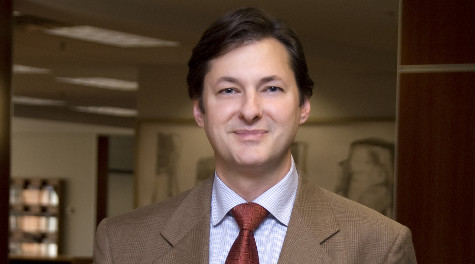 Michael Steven Green Professor Green is the Robert E. and Elizabeth S. Scott Research Professor for 2010-2011.
For many scholars, a tenure-track position in a prestigious philosophy department would be a career end-goal. For William & Mary Law School Professor Michael Steven Green, it was just the beginning.
Green, currently the Robert E. and Elizabeth S. Scott Research Professor, previously had a robust career as a philosophy professor at Tufts University. “I was very happy at Tufts,” Green recollects. “It was a marvelous place to do philosophy – with great colleagues, bright students, and a relatively light teaching load. But I couldn't help feeling that if I stayed in philosophy I would be thinking about the same set of problems (and probably giving the same answers) for the rest of my life,” Green says. “I was in my early thirties and I figured I was facing my last chance to set off in a new direction. For a while I regretted the decision, but over time I've come to the conclusion that I made the right choice.”
Green left Tufts to attend Yale Law School. He then clerked for Judge Richard Posner on the U.S. Court of Appeals for the Seventh Circuit. That prominent clerkship afforded Green the opportunity to gain valuable familiarity with a wide range of legal issues and increased his comfort level in analyzing the law. “The clerkship was a real education,” he remembers. “My co-clerk and I would read all the briefs in a case and then, before giving us his views, Judge Posner would ask us for ours. In the beginning I was way off – too far out of the ballpark to even be wrong,” Green laughs. “Gradually I came to see what was and was not legally relevant. One of the most important skills I learned was what not to think about – to realize what issues were non-starters.”
Green spent a year as an associate with the law firm Paul, Weiss in New York City, but, he says, he always knew he wanted to return to the classroom. He began teaching law at George Mason University, where he was granted tenure in 2005. In 2006, he joined the faculty of William & Mary Law School.
Green notes that his philosophy background strengthens his legal scholarship in a variety of ways. “As a philosopher, my primary area of research – Kant and 19th Century German philosophy – had nothing to do with the law. So when I entered legal academia I knew that I would have to retrain myself. In fact, I've been pleasantly surprised by one area where what I know about Kant has been useful in the philosophy of law – namely, Hans Kelsen,” Green says. “But in general it has been my training in philosophical reasoning and argument, rather than any particular body of philosophical knowledge, that has been most useful in my legal work.”
Green likes to follow his interests wherever they take him. Sometimes his topics are in the philosophy of law, but he often branches out into new and unrelated areas. For example, Green has written about the Second Amendment and copyright law. He has also branched out in his teaching, offering an undergraduate seminar on Nietzsche in the Philosophy Department at William & Mary.
The wide-ranging nature of Green’s scholarship and the reach of his work are admired by his colleagues. “Professor Green is a rising star in the field of legal theory,” notes Lawrence A. Alexander, Warren Distinguished Professor of Law at University of San Diego School of Law. “He has written several significant articles on the nature of law, and particularly on the irrelevance of the philosophy of language to that topic. In addition, his articles on legal revolutions, on Hans Kelsen, and on legal realism establish him as a major figure in jurisprudence. But he has also turned his fine analytical mind to such diverse substantive topics as the right to bear arms, copyright, and, most recently, choice of laws. His scholarship will likely end up as broad in scope as it is strong and deep.”
“Michael Green is a brilliant and talented analytical legal philosopher,” says Matthew Adler, Leon Meltzer Professor of Law at University of Pennsylvania Law School. “Anyone who converses with Michael or reads his work can attest to the power of his intellect. Michael’s contributions at the fertile intersection of constitutionalism and jurisprudence – the area I know best – include the rigorous development of a Kelsenian account of the foundations of constitutional law.”
“Michael Green’s philosophy training gives his work a rigor and analytical precision that you rarely find among law professors,” says Professor Kermit Roosevelt, who also teaches at Penn. “In a world where so much scholarship is advocacy-driven, it’s wonderful to have someone who truly cares about ideas and is so good at exploring them. I’ve learned a lot from his writing about choice of law, which is some of the most keen and insightful work on that topic in generations.”
Most recently, Green’s research has concentrated on problems in civil procedure and the conflict of laws – particularly the Erie doctrine – that have little to do with his philosophical interests or background. “I’m currently working on an article on the non-constitutional Erie doctrine as seen in cases like Guaranty Trust v. York and Gasperini v. Center for Humanities,” he says.
“Michael Green is both a top-notch scholar and a great colleague,” says Professor Scott Dodson of William & Mary Law School. “His work on Erie is groundbreaking and influential. And his work on behalf of the law school has been invaluable. As a mentor to me and other junior professors, he has been a constant source of sage advice. William & Mary would not be the same without him.”
Neal Devins, Goodrich Professor of Law and Director of William & Mary Law School’s Institute of Bill of Rights Law, echoes that sentiment. “Michael is a big part of the glue that holds our faculty together,” says Devins. “He is extraordinarily engaging and collegial, and able to talk about any legal or jurisprudential topic that anyone has ever written on (or thought of writing on).”
Green’s unique educational background and diverse interests serve as the foundation for his strong presence in the classroom. He has a reputation for challenging his students. They comment that he brings a sense of enthusiasm to subjects like Civil Procedure, which often seems dense and difficult to first-year law students. “I think my students usually appreciate that I'm heavily invested in their learning the material and that I have high expectations of them because I think these expectations can be met,” he notes. “I'd teach differently if I weren’t sure that William & Mary students are very bright.”
Likewise, Green says he has been challenged by students who become engaged with and question the material he teaches. “Students' questions can force you to look at material in new ways, because they approach it without any preconceptions. I remember in particular an answer that a student gave to an Erie question on an exam a few years ago,” Green recalls. “Responding to what the student said forced me to rethink my views on the non-constitutional Erie doctrine. The project I am currently working on is, in a sense, a product of that student’s comment.”
It is a telling indication of Green’s commitment to broad-based scholarship that a single comment from a student can spark an entirely new area of research for him. Given what he’s done so far in his career, though, it is hardly surprising.
***
To read an excerpt from Professor Green's forthcoming article, "Horizontal Erie and the Presumption of Forum Law," please click here.